
Fixed-Rate vs. Adjustable-Rate Mortgages: How the Numbers Work Over Time
The choice between a fixed and adjustable rate affects your payment for years. Here's how each structure works and what drives the difference.
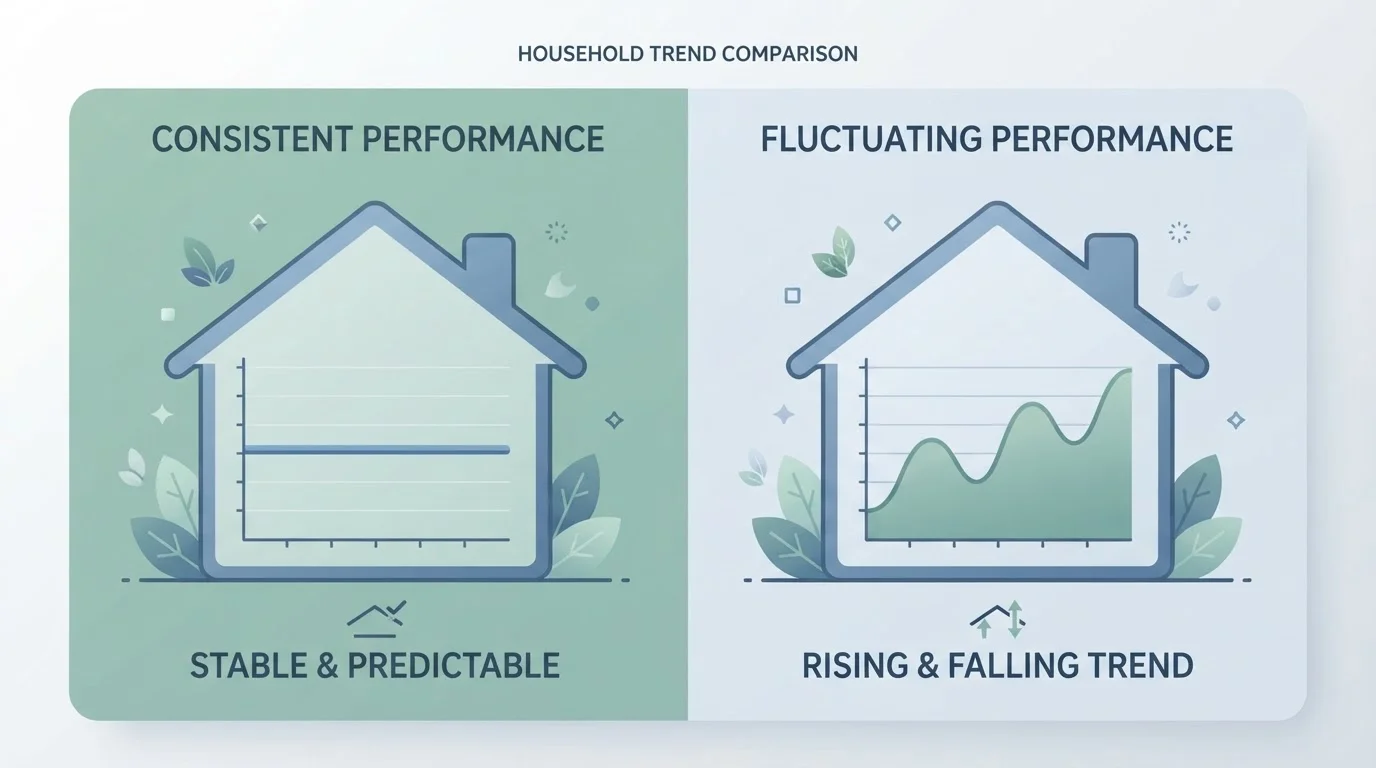
Photo: ReadersChronicle.com | Your Comprehensive Learning Destination editorial
—— In This Article
Key Takeaways
- A fixed-rate mortgage locks in your interest rate for the entire loan term, making monthly payments predictable.
- An ARM offers a lower introductory rate that resets periodically based on a financial index, introducing payment variability.
- The total interest paid over the loan's life can differ significantly between the two structures depending on how long you keep the loan.
- ARM rate caps limit how much your interest rate can rise per adjustment period and over the loan's lifetime.
- Choosing between the two depends on your time horizon, risk tolerance, and current interest rate environment.
How Each Loan Structure Sets Your Interest Rate
A fixed-rate mortgage establishes one interest rate at closing that applies to every payment for the life of the loan - whether that's 15, 20, or 30 years. If you borrow at 6.5%, every monthly principal-and-interest payment is calculated at 6.5%, month one through the final payment.
An adjustable-rate mortgage (ARM) works in two phases. The first phase is a fixed introductory period - commonly expressed as the first number in a label like "5/1 ARM" or "7/1 ARM." A 5/1 ARM holds its initial rate steady for five years. After that, the rate adjusts once per year (the "1") based on a benchmark financial index - often the Secured Overnight Financing Rate (SOFR) - plus a set margin determined by the lender.
Because lenders take on more long-term interest rate risk with a fixed loan, fixed rates are typically higher at origination than an ARM's introductory rate. That spread is the core trade-off every borrower is evaluating. For a deeper look at how fixed versus variable costs behave in any budget, see our overview of fixed and variable expenses.
| Criterion | Fixed-Rate Mortgage | Adjustable-Rate Mortgage (ARM) |
|---|---|---|
| Interest rate over time | Stays the same for the full loan term | Fixed initially, then adjusts periodically |
| Initial rate | Typically higher at origination | Typically lower during intro period |
| Monthly payment stability | Completely predictable | Can rise or fall after intro period |
| Rate change protection | No rate risk - locked in at closing | Rate caps limit adjustment size |
| Best time horizon | Long-term ownership (10+ years) | Short-to-medium term (under 7 years) |
| Total interest risk | Known from day one | Uncertain; depends on future index rates |
| Refinancing incentive | Lower when rates fall significantly | May not be necessary if rate drops naturally |
What Drives ARM Rate Changes - and How Caps Protect You
When an ARM exits its introductory period, its new rate is calculated as: index rate + lender margin = your new interest rate. If the SOFR index is 4.5% and your margin is 2.25%, your adjusted rate becomes 6.75%. The index fluctuates with broader monetary policy; the margin is fixed at closing.
Federal regulations require lenders to disclose three types of rate caps on every ARM:
- Initial adjustment cap: Limits how much the rate can increase at the very first reset (commonly 2%).
- Periodic adjustment cap: Limits increases at each subsequent reset (commonly 2% per year).
- Lifetime cap: The maximum rate can never exceed this ceiling above the initial rate (commonly 5%).
So a 5/1 ARM that starts at 5.5% with a 2/2/5 cap structure can rise to no more than 7.5% at first adjustment, and no higher than 10.5% ever - regardless of where the index goes. Understanding these caps is essential because they define your worst-case payment scenario.
ARM Disclosures: What Lenders Must Provide
Under federal rules, lenders are required to give ARM borrowers a standardized disclosure - sometimes called the "CHARM booklet" - explaining how rate adjustments work. You must also receive advance notice before any rate change takes effect. Review these documents carefully at closing and keep them for reference when your first adjustment period approaches. The Consumer Financial Protection Bureau (CFPB) website provides plain-language guides on ARM disclosure requirements.
Running the Numbers: How Costs Diverge Over Time
Consider a $350,000 loan. A 30-year fixed at 7.0% produces a monthly principal-and-interest payment of roughly $2,329 and total interest of approximately $488,400 over three decades. A 5/1 ARM opening at 5.5% starts at about $1,987 per month - saving roughly $342 monthly in years one through five.
That early savings totals around $20,500 over the introductory period. But if rates rise after year five and the ARM climbs toward its lifetime cap, the calculus reverses. By year 10, cumulative interest on the ARM could surpass the fixed-rate scenario, depending on how the index moves.
This is why time horizon matters so much. Our article on how amortization schedules work explains that the bulk of early payments go toward interest regardless of loan type - understanding that math helps you see exactly where each structure costs you more.
~$342/mo
Typical early payment savings with a 5/1 ARM vs. 30-year fixed
Based on a $350,000 loan comparing a 5.5% ARM intro rate to a 7.0% fixed rate - illustrative example, not a guarantee.
5%
Common ARM lifetime rate cap above initial rate
Most ARM disclosures include a lifetime cap; the Consumer Financial Protection Bureau (CFPB) provides standardized ARM disclosure requirements for lenders.
5-7 years
Median time US homeowners keep a mortgage before refinancing or selling
Industry data consistently shows many borrowers exit their original loan well before the 30-year term ends, making the ARM introductory period relevant for many buyers.
If you are still deciding whether homeownership makes sense at all, our renting vs. buying comparison can help you weigh the broader financial picture before committing to any mortgage structure.
This article is for general informational and educational purposes only and does not constitute personalized financial, mortgage, or legal advice. Loan terms, rates, and regulations vary by lender, state, and market conditions. Consult a licensed mortgage professional or financial adviser for guidance specific to your situation.

Real Estate Basics Editorial Team
Real Estate Basics Editorial Team is the collective byline for our editorial team and contributor network. Articles published under this byline or an editorial pen name are researched, written, and reviewed according to our editorial standards for clarity, consistency, and independence before publication.
View author profile