
Renting vs. Buying: Making Sense of the Trade-Offs
Buying isn't always better than renting — and vice versa. Weigh the financial and lifestyle factors before committing either way.
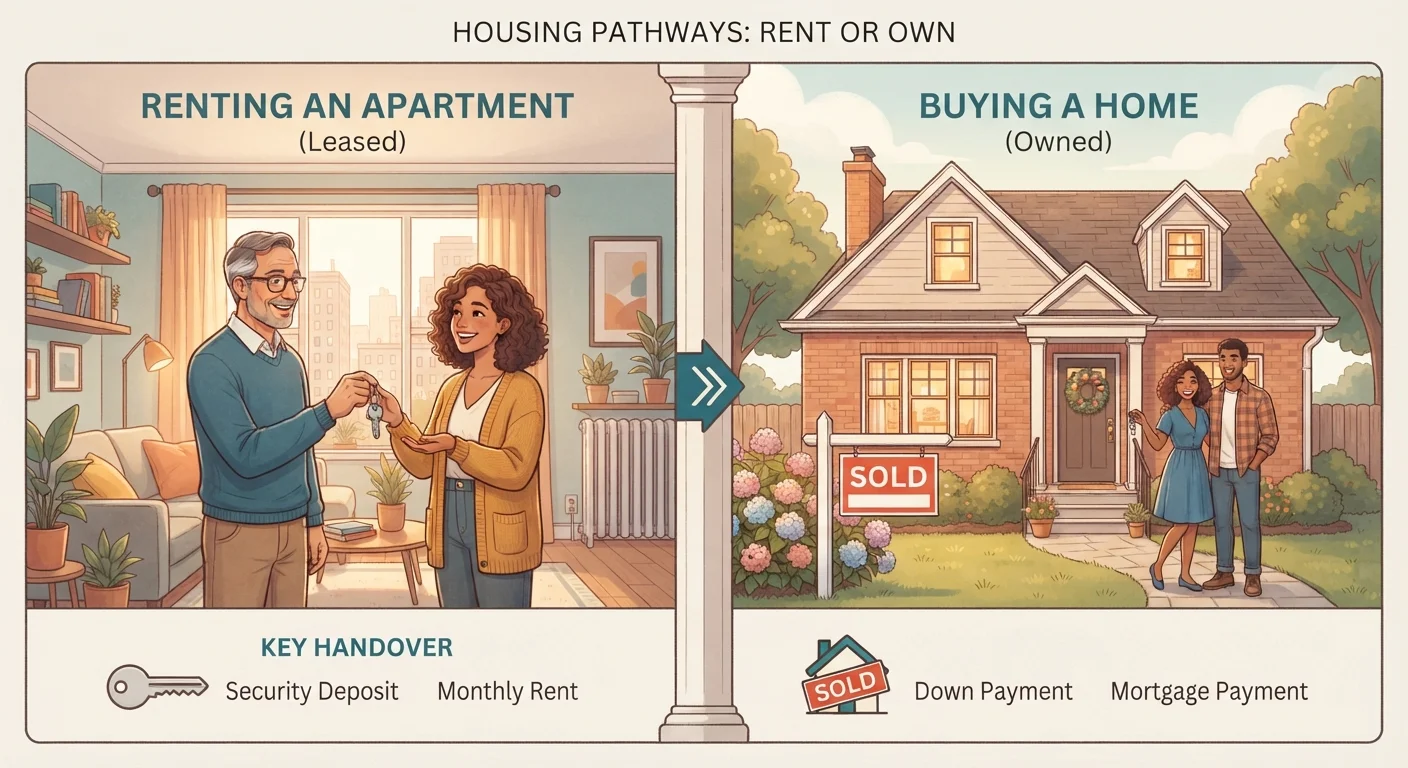
Photo: ReadersChronicle.com | Your Comprehensive Learning Destination editorial
—— In This Article
Key Takeaways
- Buying builds equity over time but requires significant upfront costs and long-term commitment.
- Renting offers flexibility and predictable monthly expenses with no maintenance responsibility.
- The right choice depends on your financial stability, timeline, and local housing market.
- Neither renting nor buying is universally better - both serve different life situations.
- Hidden costs on both sides - like maintenance for owners and rent increases for renters - affect the real comparison.
Builds equity with each mortgage payment
Unlike rent, mortgage payments gradually increase your ownership stake in the property. Over time, that equity represents real, accessible wealth.
Fixed-rate mortgages provide payment predictability
A fixed-rate loan locks in your principal and interest payment for the loan's duration, shielding you from the rent increases that renters face at renewal.
Freedom to customize and renovate
Owners can paint, remodel, landscape, or make structural changes without seeking landlord permission, offering meaningful control over their living space.
Potential appreciation in property value
Real estate values have historically trended upward in many US markets over long periods, though this is not guaranteed and varies significantly by location and market cycle.
Stability and community rootedness
Owning a home often encourages longer-term residence, which can strengthen community ties, school continuity for children, and a sense of permanence.
No maintenance or repair responsibility
When major systems fail - HVAC, plumbing, roof - the landlord bears the cost and coordination burden, not the renter. This can represent significant savings and peace of mind.
Flexibility to relocate without major financial consequence
Ending a lease typically requires 30-60 days' notice, while selling a home involves months of process and transaction costs that can easily reach 6-10% of the sale price.
Lower barrier to entry - no down payment required
Renting generally requires a security deposit and first month's rent, far less capital than the down payment, closing costs, and cash reserves needed to purchase a home.
Predictable monthly expenses in the short term
A lease locks in rent for its term, making budgeting straightforward - there are no surprise repair bills, property tax reassessments, or insurance premium increases to absorb.
The Core Question: Why This Decision Is So Personal
Few financial decisions carry as much weight as whether to rent or buy a home. For many Americans, homeownership still feels like an expected milestone - but that expectation can obscure whether buying actually makes sense for a given person at a given moment. The truth is that renting is not throwing money away, and buying is not always a guaranteed path to wealth.
The decision hinges on factors that are unique to each household: how long you plan to stay in an area, the state of your savings, your local housing market, and how much financial and logistical responsibility you are ready to take on. This article breaks down the practical trade-offs on both sides so you can make a clearer-headed choice.
For a deeper look at the lifestyle dimensions beyond finances, see the lifestyle and responsibility trade-offs between renting and owning.
The Case for Buying
Owning a home comes with advantages that renting simply cannot replicate. The most significant is equity - the portion of the home's value you actually own, which grows as you pay down your mortgage and, in many markets, as property values rise over time. That equity can eventually be tapped or converted into proceeds when you sell.
Builds equity with each mortgage payment
Unlike rent, mortgage payments gradually increase your ownership stake in the property. Over time, that equity represents real, accessible wealth.
Fixed-rate mortgages provide payment predictability
A fixed-rate loan locks in your principal and interest payment for the loan's duration, shielding you from the rent increases that renters face at renewal.
Freedom to customize and renovate
Owners can paint, remodel, landscape, or make structural changes without seeking landlord permission, offering meaningful control over their living space.
Potential appreciation in property value
Real estate values have historically trended upward in many US markets over long periods, though this is not guaranteed and varies significantly by location and market cycle.
Stability and community rootedness
Owning a home often encourages longer-term residence, which can strengthen community ties, school continuity for children, and a sense of permanence.
Buyers also gain stability in monthly payments when they choose a fixed-rate mortgage. Unlike rent, which a landlord can raise at renewal, a fixed mortgage principal and interest payment stays the same for the life of the loan. Understanding how that works is worth your time - see how fixed and adjustable mortgages compare before choosing a loan structure.
Homeowners also have freedom to renovate, decorate, or modify their property without landlord approval - a meaningful quality-of-life factor for many families.
The Case for Renting
Renting is often portrayed as a temporary or inferior arrangement, but that framing ignores real advantages. Renters carry no responsibility for major repairs - a failed water heater or roof leak is the landlord's problem, not yours. That predictability can be genuinely valuable on a tight budget.
No maintenance or repair responsibility
When major systems fail - HVAC, plumbing, roof - the landlord bears the cost and coordination burden, not the renter. This can represent significant savings and peace of mind.
Flexibility to relocate without major financial consequence
Ending a lease typically requires 30-60 days' notice, while selling a home involves months of process and transaction costs that can easily reach 6-10% of the sale price.
Lower barrier to entry - no down payment required
Renting generally requires a security deposit and first month's rent, far less capital than the down payment, closing costs, and cash reserves needed to purchase a home.
Predictable monthly expenses in the short term
A lease locks in rent for its term, making budgeting straightforward - there are no surprise repair bills, property tax reassessments, or insurance premium increases to absorb.
Renting also offers mobility. If your job changes, your family circumstances shift, or you simply want to live somewhere new, leaving a rental is far simpler than selling a home. In high-cost markets, renting can also free up capital that would otherwise be locked into a down payment and closing costs - money that could be saved, invested, or used for other priorities.
Before signing any lease, it pays to read the fine print carefully. Our guide on reading a lease before you sign walks through what to look for in a rental agreement. If flexibility is a priority, you may also want to understand how month-to-month and fixed-term leases differ.
The Financial Reality: What the Numbers Actually Include
Direct cost comparisons between renting and buying are easy to oversimplify. A mortgage payment alone is not the full cost of ownership. Buyers should account for property taxes, homeowners insurance, private mortgage insurance (PMI) if the down payment is below 20%, HOA fees where applicable, and ongoing maintenance - commonly estimated at roughly 1% of the home's value per year, though this varies widely.
~1%
Annual home maintenance cost estimate
Many financial planners suggest budgeting roughly 1% of a home's purchase price per year for routine maintenance, though actual costs vary widely by home age and condition.
6-10%
Typical transaction cost range when selling a home
Seller-side closing costs, agent commissions, and related fees commonly total between 6% and 10% of the sale price, a significant factor in short-term ownership calculations.
5+ years
Common break-even horizon for buying vs. renting
Housing economists often cite a five-year minimum stay as a general threshold at which buying may begin to make financial sense over renting, though this depends heavily on local market conditions.
Renters, meanwhile, face the risk of rent increases at lease renewal and have no guarantee of long-term stability in a given unit. Neither side is expense-free.
One useful rule of thumb is the price-to-rent ratio: divide a home's purchase price by the annual rent for a comparable property. A higher ratio generally favors renting; a lower ratio generally favors buying - but local market conditions vary significantly. If you are approaching this as a first-time buyer on a limited budget, a guide to the homebuying process on a tight budget offers practical grounding.
How the Price-to-Rent Ratio Works
The price-to-rent ratio compares the purchase price of a home to the annual rent for a comparable property. For example, a home priced at $300,000 in a market where similar homes rent for $18,000 per year has a ratio of about 16.7. Ratios above 20 are generally interpreted as favoring renting; ratios below 15 may favor buying. This is a general heuristic, not a definitive rule, and should be combined with your personal financial picture.
This article is for general informational purposes only and does not constitute financial, legal, or real estate advice. Consult a licensed financial adviser or real estate professional before making decisions about buying or renting a home.

Real Estate Basics Editorial Team
Real Estate Basics Editorial Team is the collective byline for our editorial team and contributor network. Articles published under this byline or an editorial pen name are researched, written, and reviewed according to our editorial standards for clarity, consistency, and independence before publication.
View author profile