
Amortization Explained: Why Early Mortgage Payments Are Mostly Interest
Amortization schedules determine how your payment is split between interest and principal each month. Here's the math behind what you're paying — and when.
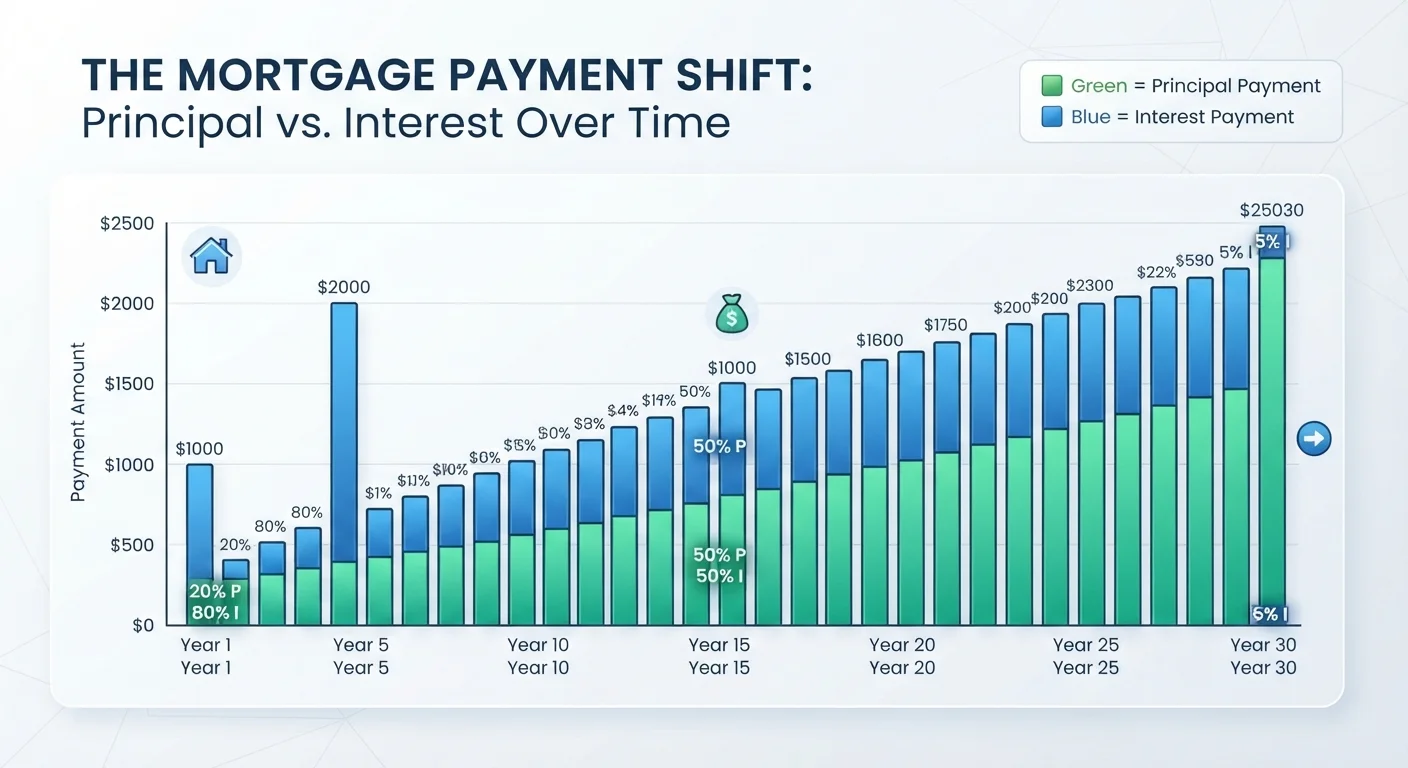
Photo: ReadersChronicle.com | Your Comprehensive Learning Destination editorial
—— In This Article
Key Takeaways
- Early mortgage payments are mostly interest because interest is charged on the full remaining balance.
- The principal-to-interest ratio gradually shifts in your favor over the life of the loan.
- A 30-year mortgage accrues significantly more total interest than a 15-year mortgage for the same amount.
- Making extra principal payments early can dramatically reduce total interest paid.
- Your monthly payment amount stays fixed, but what it buys you changes every month.
How Your Monthly Payment Is Divided
When you make a mortgage payment, it doesn't all go toward reducing what you owe. Every payment is divided into two parts: interest (the cost of borrowing) and principal (the actual loan balance). The lender applies the interest charge first, and whatever remains reduces the principal.
Here's the key mechanism: interest is calculated as a percentage of your current remaining balance. On a $300,000 loan at 6.5% annual interest, your first month's interest charge alone is roughly $1,625. If your total payment is $1,896, only about $271 goes to principal that first month. Your balance drops to $299,729 - a modest start after a full payment.
This isn't a lender trick; it's basic math. The formula that produces a fixed monthly payment guarantees the loan reaches zero at the end of the term, but it means the early years are expensive in terms of interest paid.
~$382,000
Total interest on a 30-year $300K loan at 6.5%
Calculated using a standard amortization formula on a $300,000 loan at 6.5% annual interest over 360 monthly payments.
<$300
Principal paid in month one of that same loan
On a $300,000 loan at 6.5%, the first payment applies roughly $1,625 to interest and under $275 to the outstanding principal balance.
~Year 18
When payments tip majority toward principal (30-yr at 6.5%)
Based on standard amortization math; the exact crossover month varies with the loan's specific interest rate and balance.
The Amortization Schedule: Reading the Numbers
An amortization schedule is a month-by-month table showing exactly how each payment is split and what balance remains. Under federal lending rules, lenders are required to provide this document at closing. It's worth reviewing - the numbers can be illuminating.
On a 30-year, $300,000 loan at 6.5%, the total of all 360 payments would be roughly $682,000. That means you'd pay approximately $382,000 in interest over the life of the loan - more than the original amount borrowed. The amortization schedule makes this visible in a way that the monthly payment amount alone does not.
Homebuying terms like amortization can seem abstract before you're sitting with a loan document. Seeing the full schedule puts the concept in concrete dollar terms.
What You Can Do With This Knowledge
Understanding amortization gives you real leverage. A few practical strategies are worth knowing:
- Extra principal payments: Any amount you add beyond your required payment that is designated toward principal reduces your balance immediately. On a 30-year mortgage, paying an extra $100-$200 per month in the early years can shave years off the loan and save tens of thousands in interest. Check with your lender about how to direct extra payments properly.
- Loan term comparison: A 15-year mortgage typically has a lower rate and builds equity far faster, but requires a higher monthly payment. The comparison between fixed-rate structures can help clarify what each term length actually costs over time.
- Refinancing awareness: If you refinance, you generally restart the amortization clock. Refinancing a 30-year loan after 10 years into a new 30-year loan means spending additional years in interest-heavy early payments, even if the new rate is lower.
If you're also managing other debt alongside a mortgage, the framework in balancing savings and debt payoff can help you prioritize where extra dollars go.
Check Your Amortization Schedule Early
Request or generate a full amortization table before or shortly after closing. Many free online calculators can produce one in seconds. Review the first few years closely - seeing exactly how little of each early payment reduces your balance is the clearest motivation to make extra principal payments when you can afford to.
This article is for general informational purposes only and does not constitute financial or mortgage advice. Consult a licensed financial professional for guidance tailored to your specific circumstances.
Frequently Asked Questions

Real Estate Basics Editorial Team
Real Estate Basics Editorial Team is the collective byline for our editorial team and contributor network. Articles published under this byline or an editorial pen name are researched, written, and reviewed according to our editorial standards for clarity, consistency, and independence before publication.
View author profile