
Whole Grains: What Qualifies and What Doesn't
"Whole grain" appears on everything from bread to crackers. Learn what the label actually requires and how to spot genuine whole grain foods.
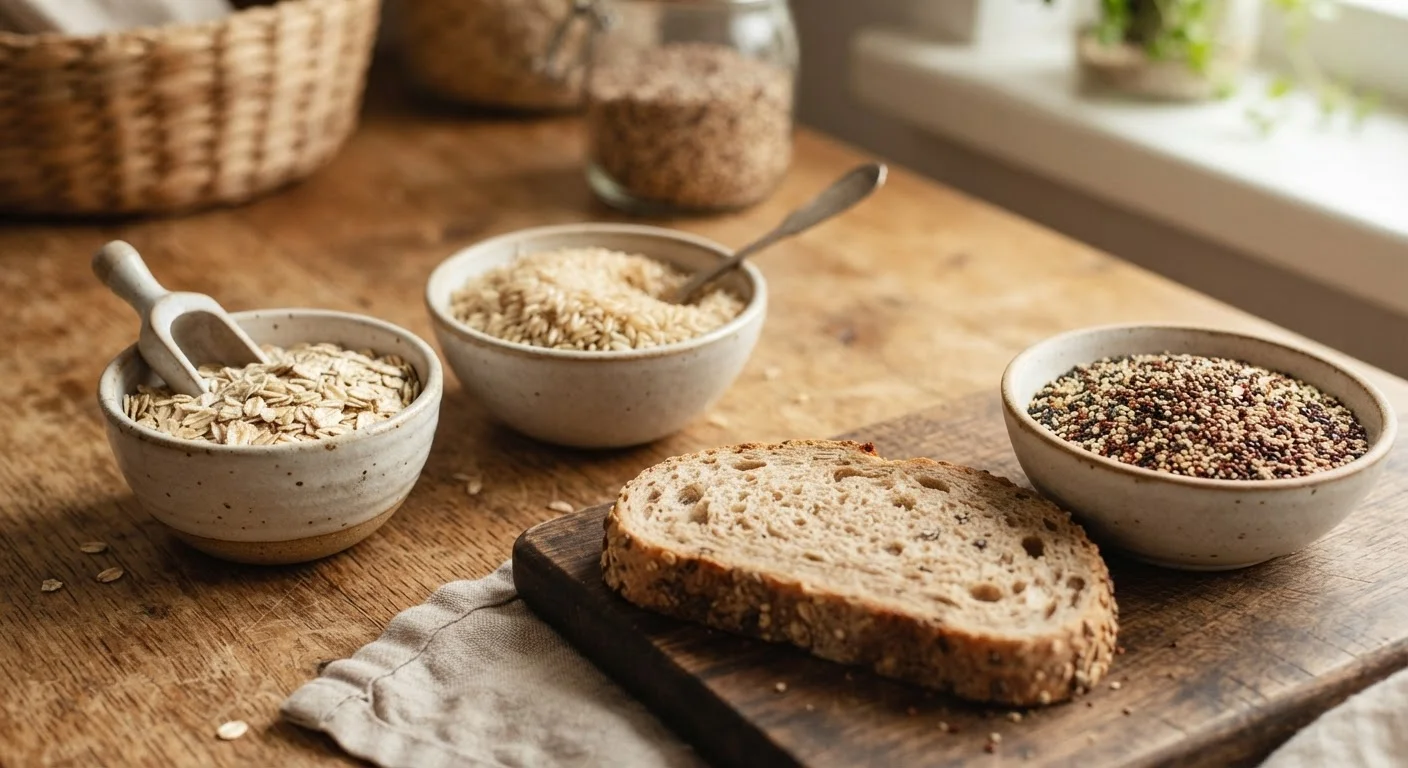
Photo: ReadersChronicle.com | Your Comprehensive Learning Destination editorial
—— In This Article
Key Takeaways
- A true whole grain retains its bran, germ, and endosperm - all three parts of the kernel.
- "Multigrain" and "made with whole grains" are not the same as "100% whole grain."
- Check the ingredient list: a whole grain should appear as the first grain ingredient.
- Color alone is not a reliable indicator - brown bread isn't automatically whole grain.
- Whole grains provide more fiber, vitamins, and minerals than their refined counterparts.
- Affordable whole grain options like oats, brown rice, and whole wheat flour are widely available.
The Three Parts That Make a Grain "Whole"
Every grain kernel is made up of three distinct layers, and a grain is only considered "whole" when all three are preserved:
- Bran: The tough outer shell, rich in fiber, B vitamins, and antioxidants.
- Germ: The embryo of the seed, packed with healthy fats, vitamin E, and additional B vitamins.
- Endosperm: The largest portion, made mostly of starch and some protein - this is what refined grains retain after processing.
When grains are refined - as with white flour or white rice - the bran and germ are stripped away. This extends shelf life but removes a significant portion of the fiber and micronutrients. The endosperm left behind is less nutritionally complex, even when products are later "enriched" with added vitamins.
Common examples of true whole grains include whole wheat, oats, brown rice, quinoa, barley, rye, bulgur, millet, and corn (when consumed as whole cornmeal or popcorn). Each retains its full kernel structure.
95%
Americans not meeting whole grain recommendations
According to data cited by the Whole Grains Council, approximately 95% of Americans fall short of the recommended whole grain intake.
3+
Grams of fiber in a true whole grain serving
Most foods that qualify as a good source of whole grains provide at least 3 grams of dietary fiber per serving, per general FDA labeling benchmarks.
½
Minimum share of grains that should be whole
The Dietary Guidelines for Americans recommend that at least half of all grain consumption come from whole grain sources.
What the Label Does - and Doesn't - Guarantee
Food marketing has made "whole grain" one of the most misunderstood terms on grocery shelves. Here's how to decode the most common claims:
- "100% Whole Grain"
- The strongest claim. Every grain ingredient in the product is whole grain. This is what you want to see if maximizing whole grain content is a priority.
- "Whole Grain" (without "100%")
- The product contains some whole grain, but may also include refined grains. The amount isn't specified on the front of the package.
- "Made with Whole Grains"
- There is no minimum threshold for how much whole grain must be present. A product with this claim could contain very little.
- "Multigrain"
- Simply means more than one type of grain was used. Those grains can be entirely refined. This term carries no whole grain guarantee whatsoever.
- "Stone-ground" or "Cracked wheat"
- These describe milling methods, not whether all three kernel parts are retained. They don't automatically mean whole grain.
For a deeper look at how food labels use regulated and unregulated terms, see our guide on interpreting health claims on packaged food.
The Ingredient List Is Your Best Tool
Ignore front-of-package claims and go straight to the ingredient list. The first grain ingredient tells you the most about what you're actually getting. If "whole" doesn't appear before the grain name (e.g., "whole wheat," "whole oat"), that grain is likely refined. This one habit can help you cut through nearly all whole grain marketing confusion.
How to Verify Whole Grain Content on Any Package
The front of a package is marketing. The ingredient list is where the truth lives. Here's a reliable process for evaluating any grain-based product:
- Find the ingredient list. Ingredients are listed in descending order by weight.
- Look at the first grain ingredient. If it says "whole wheat flour," "whole oat flour," "brown rice," or another named whole grain, that's a strong signal. If it says "enriched wheat flour" or "rice flour" without the word "whole," the primary grain is refined.
- Scan for added refined grains. Even if a whole grain appears first, refined grains listed later in the mix reduce the product's overall whole grain percentage.
- Check fiber content. Whole grain products generally provide at least 2-3 grams of dietary fiber per serving. This isn't a standalone test, but it's a useful cross-check alongside the ingredient list.
Understanding the full ingredient list and nutrition panel together gives you the clearest picture. Our guide to reading nutrition facts labels walks through each section in plain language.
The Whole Grain Stamp: Helpful but Not the Whole Picture
The Whole Grain Council's stamp is a voluntary labeling tool used by many manufacturers. A "100% Whole Grain" stamp indicates all grain ingredients are whole; a basic stamp means the product contains at least 8 grams of whole grain per serving but may also include refined grains. The stamp is a useful shortcut, but reading the ingredient list remains the most reliable verification method.
Affordable Whole Grains Worth Knowing
Budget-conscious shoppers don't need specialty products to eat more whole grains. Some of the most nutritious options are also among the most economical:
- Rolled oats: Widely available in bulk, inexpensive, versatile, and a verified whole grain with well-documented fiber content.
- Brown rice: Costs only marginally more than white rice and retains its bran and germ. Comparing brown and white rice shows the nutritional differences in detail.
- Whole wheat flour: A direct substitute for all-purpose flour in many recipes and widely sold in standard grocery stores.
- Popcorn: Yes - air-popped popcorn is a whole grain snack with minimal processing.
- Barley and bulgur: Often sold in bulk bins at lower cost, both are whole grains that work well in soups, salads, and side dishes.
Choosing store-brand versions of these staples can reduce costs further without any sacrifice in nutritional quality. The grain itself - not the brand - is what matters.
This article is for general informational purposes only and is not a substitute for professional medical or dietary advice. Consult a registered dietitian or qualified healthcare provider for guidance tailored to your individual health needs.
Frequently Asked Questions

Health Editorial Team
Health Editorial Team is the collective byline for our editorial team and contributor network. Articles published under this byline or an editorial pen name are researched, written, and reviewed according to our editorial standards for clarity, consistency, and independence before publication.
View author profile