
Paper vs. App: Weighing Your Budget Tracking Options
Spreadsheets, notebooks, and digital apps each have trade-offs. A balanced look at the pros and cons of common budget tracking formats.
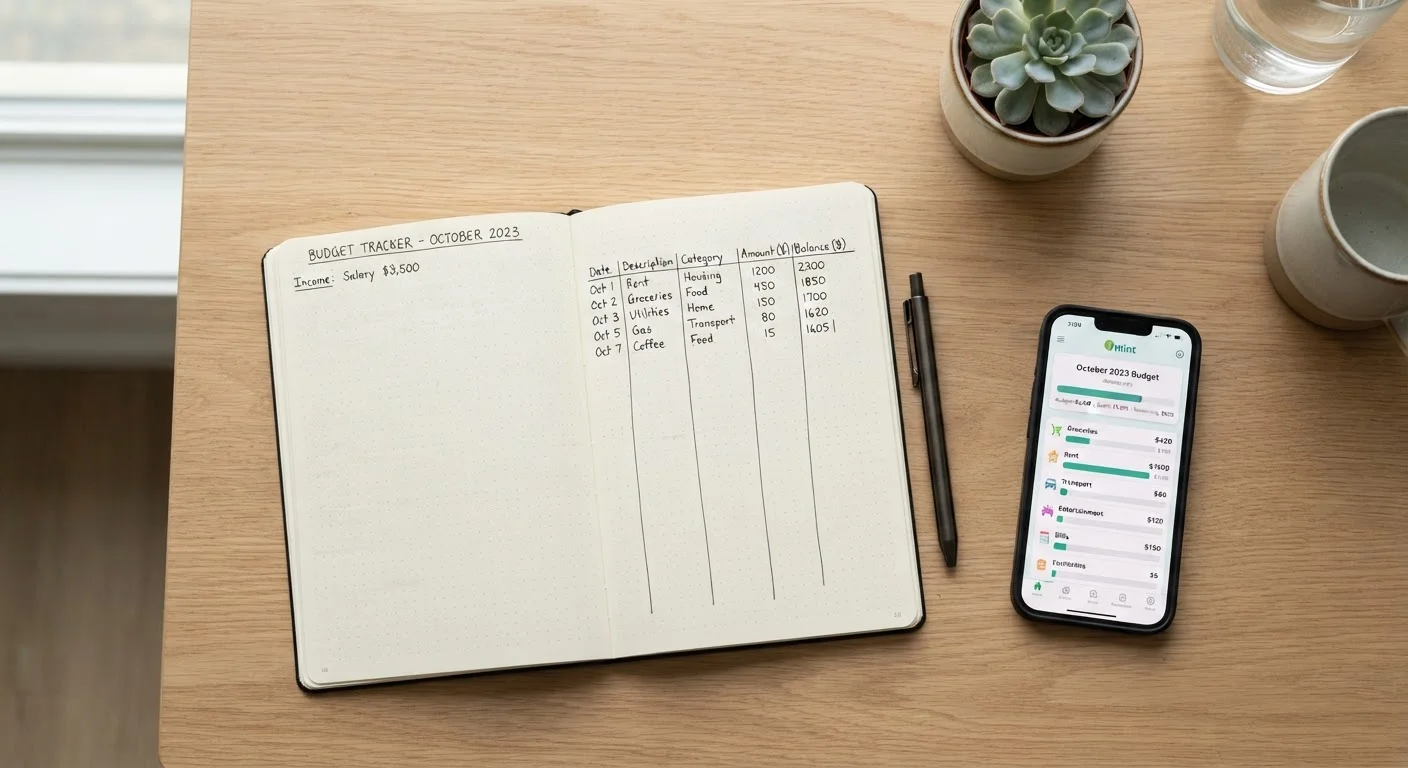
Photo: ReadersChronicle.com | Your Comprehensive Learning Destination editorial
—— In This Article
Key Takeaways
- Paper budgeting builds slower, more deliberate spending awareness through manual record-keeping.
- Budget apps automate transaction imports and can alert you to overspending in real time.
- Spreadsheets offer a middle ground - more structure than paper, more flexibility than most apps.
- The format that gets used consistently is better than the 'perfect' format used sporadically.
- Privacy and data security are legitimate concerns worth reviewing before connecting any app to a bank account.
Writing by hand reinforces spending awareness
The physical act of recording a purchase slows down automatic spending behavior and builds a more conscious relationship with money over time.
No accounts to link, no privacy trade-offs
Paper requires no internet connection, no app permissions, and no sharing of bank credentials - useful for anyone concerned about financial data security.
Zero cost and no technology required
A notebook and pen cost almost nothing and work anywhere, making paper budgeting accessible regardless of tech comfort level or device access.
No automatic totals or running balances
Every calculation is manual, which increases the chance of arithmetic errors and makes it harder to get a quick snapshot of where you stand mid-month.
Easy to fall behind on entries
Card swipes, online purchases, and recurring charges require deliberate manual entry - missing even a few transactions can make the record unreliable.
Limited ability to spot trends over time
Comparing spending across several months on paper requires manually scanning multiple pages, which most people simply don't do with regularity.
Why Your Tracking Format Actually Matters
Budgeting advice often focuses on which method to follow - zero-based, 50/30/20, envelope - but the format you use to track it matters just as much. If the system is inconvenient or doesn't fit how you think, you'll abandon it. Research in behavioral economics consistently shows that friction reduces follow-through, meaning the harder it is to log a purchase, the less likely you are to do it.
This isn't about finding the most sophisticated tool. It's about finding the one you'll actually open. Whether that's a spiral notebook, a free spreadsheet, or a synced app, consistency beats cleverness every time. See how this logic plays out in practice with our look at envelope budgeting adapted for today's world.
There Is No Single Right Answer
Personal finance educators and nonprofit credit counseling organizations generally agree that the best budgeting tool is the one a person will actually use consistently. Some people combine formats - for example, using paper for weekly cash spending and a spreadsheet for monthly totals. Hybrid approaches are completely valid and often more sustainable than committing rigidly to one method.
The Case for Paper
Writing purchases by hand forces a brief moment of attention that typing doesn't always require. Many people who track on paper report a stronger gut-level sense of where money is going - partly because the act of writing encodes information more deeply than tapping a screen.
Writing by hand reinforces spending awareness
The physical act of recording a purchase slows down automatic spending behavior and builds a more conscious relationship with money over time.
No accounts to link, no privacy trade-offs
Paper requires no internet connection, no app permissions, and no sharing of bank credentials - useful for anyone concerned about financial data security.
Zero cost and no technology required
A notebook and pen cost almost nothing and work anywhere, making paper budgeting accessible regardless of tech comfort level or device access.
The drawbacks are real, too. Paper offers no automatic totals, no alerts, and no sync with your bank. If you lose the notebook or forget to record a debit card swipe, the numbers go stale fast. Paper works best for people managing a simple, mostly cash-based budget or anyone who finds screen-based tools distracting.
No automatic totals or running balances
Every calculation is manual, which increases the chance of arithmetic errors and makes it harder to get a quick snapshot of where you stand mid-month.
Easy to fall behind on entries
Card swipes, online purchases, and recurring charges require deliberate manual entry - missing even a few transactions can make the record unreliable.
Limited ability to spot trends over time
Comparing spending across several months on paper requires manually scanning multiple pages, which most people simply don't do with regularity.
The Case for Budget Apps
Apps solve the biggest practical problem with paper: you don't have to remember to enter anything. Most budgeting apps can connect securely to your bank or credit card accounts and pull transactions automatically, categorizing them as they come in. For households managing several accounts or irregular income, that automation is genuinely valuable.
76%
US adults using mobile banking regularly
According to the Federal Reserve's 2023 report on the economic well-being of US households, a large majority of adults now use mobile or online banking, making app-based budgeting more accessible than ever.
~$3-$15/mo
Typical monthly cost of paid budget apps
Most popular budgeting apps offer a free tier with limited features, with full-featured plans generally ranging from roughly $3 to $15 per month depending on the service.
The trade-offs deserve honest attention. Connecting a financial account to a third-party app introduces security considerations - look for apps that use bank-level encryption and read-only access. There's also the subscription cost to weigh; free tiers often limit features. And app-generated categories aren't always accurate, which means periodic manual review is still necessary. If you're evaluating any app that requires a device investment, it's worth asking the right questions before buying new tech to support it.
Where Spreadsheets Fit In
A free spreadsheet - in Google Sheets or a similar tool - sits between paper and apps in almost every dimension. You get the structure of categories and automatic math, plus the flexibility to build exactly the layout you want, without linking any accounts or paying a monthly fee.
The learning curve is modest but real. You still need to enter transactions manually, and building a useful template from scratch takes time. That said, dozens of free budget templates are publicly available from libraries, credit unions, and nonprofit financial education organizations, so you don't need to start from zero. For bigger financial goals like managing travel spending, a dedicated spreadsheet can also integrate well with trip planning - see our guide on building a travel budget that holds up.
Spreadsheets reward people who are comfortable with basic formulas and want control without ongoing cost. They also make it easier to compare month-over-month spending in ways that paper can't.
How to Choose the Right Format for You
Start by asking a few practical questions: How many accounts and payment methods do you manage? How comfortable are you with manual data entry? Does the thought of linking your bank to an app concern you? Are you trying to establish a new habit or refine an existing one?
If you're new to budgeting, paper or a simple spreadsheet often works well because it keeps the process visible and low-stakes. You can always migrate to an app once you know what categories and structure make sense for your spending. The budgeting framework you choose - covered in depth in our comparison of zero-based budgeting vs. the 50/30/20 rule - matters too, and different methods pair naturally with different tracking formats.
This article is for general informational and educational purposes only and does not constitute personalized financial advice. Consider consulting a qualified financial professional for guidance specific to your situation.

Finance Editorial Team
Finance Editorial Team is the collective byline for our editorial team and contributor network. Articles published under this byline or an editorial pen name are researched, written, and reviewed according to our editorial standards for clarity, consistency, and independence before publication.
View author profile