
Smoke Detectors, CO Alarms, and Fire Extinguishers: A Homeowner's Safety Reference
Placement rules, testing schedules, expiration timelines, and replacement guidance for the safety devices every home should have.
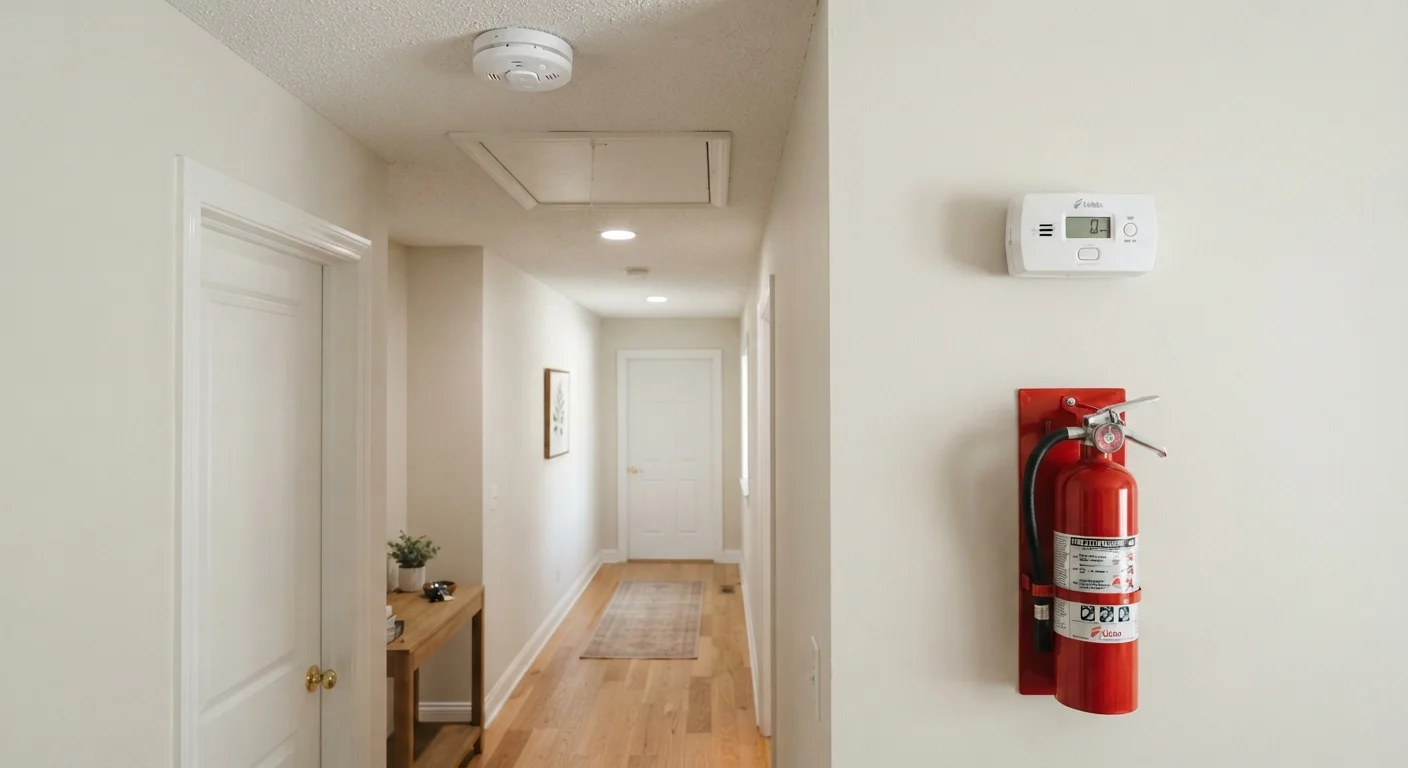
Photo: ReadersChronicle.com | Your Comprehensive Learning Destination editorial
—— In This Article
Where to Place Each Device
Placement determines whether a device can actually protect you. Here are the general guidelines - but always check your local building code, since requirements vary by state and municipality.
Smoke Detectors
- Install on every level of the home, including the basement.
- Place inside each bedroom and outside every sleeping area.
- Mount on the ceiling or high on a wall (within 12 inches of the ceiling). Smoke rises, so low placement reduces effectiveness.
- Keep them at least 10 feet from cooking appliances to reduce nuisance alarms.
- Avoid placing them near windows, vents, or ceiling fans where air movement can interfere.
Carbon Monoxide (CO) Alarms
- Install on every level of the home.
- Place one outside each sleeping area - CO poisoning often happens while people sleep.
- If your home has an attached garage or fuel-burning appliances (furnace, water heater, gas range), place a unit near those areas.
- Unlike smoke, CO mixes evenly with air, so wall-mounted units at about knee height or higher are both acceptable depending on manufacturer guidance.
Fire Extinguishers
- Keep at least one on every floor, with the kitchen being the highest priority location.
- Mount near exits so you can use it while keeping an escape route available - not in a corner that could trap you.
- Store in the garage and workshop as well, especially near fuel or power equipment.
| Smoke detector lifespan | 10 years from manufacture date (U.S. Fire Administration guidance) |
| CO alarm lifespan | 5-7 years (check back label) (General manufacturer guidance) |
| Fire extinguisher inspection frequency | Monthly visual check; annual professional inspection (NFPA 10 standard) |
| Smoke detector test frequency | Monthly (U.S. Fire Administration guidance) |
| Minimum detectors per home | One per level, plus each bedroom and outside each sleeping area (NFPA 72 National Fire Alarm Code) |
| Battery replacement (standard units) | At least once per year (General manufacturer guidance) |
Testing, Maintenance, and Replacement Timelines
Owning these devices is only half the job. A smoke detector with a dead battery or an expired extinguisher gives a false sense of security. Build these tasks into your quarterly home maintenance schedule.
3 in 5
Home fire deaths where no working smoke alarm was present
According to the National Fire Protection Association (NFPA), roughly three of every five home fire deaths occur in homes with no smoke alarm or no working smoke alarm.
10 years
Maximum service life of a smoke detector
Even if the test button still works, smoke detector sensors degrade over time and units should be replaced at the 10-year mark from manufacture date.
Smoke Detectors
- Test: Press the test button monthly.
- Clean: Vacuum gently around the unit every six months to clear dust buildup that can cause false alarms or delayed response.
- Replace batteries: At minimum once a year for standard 9-volt units - or when the low-battery chirp sounds. Sealed 10-year battery models eliminate this step.
- Replace the unit: Every 10 years from the manufacture date printed on the back. Sensors degrade over time regardless of whether the test button works.
CO Alarms
- Test: Monthly using the test button.
- Replace batteries: Annually, or as prompted.
- Replace the unit: Every 5-7 years. CO alarms have electrochemical sensors with a shorter lifespan than smoke detectors. Check the back label for the expiration date.
Fire Extinguishers
- Inspect monthly: Check that the pressure gauge needle is in the green zone, the pin and tamper seal are intact, and there is no visible damage or corrosion.
- Professional service: Have a certified technician inspect it annually.
- Hydrostatic testing: Required every 6 years for stored-pressure dry chemical extinguishers. A technician performs this to verify the cylinder integrity.
- Replace or recharge: After any use - even partial discharge. Also replace if the gauge reads low or the unit shows damage. Most single-use residential extinguishers are not rechargeable; verify yours before assuming it can be refilled.
- General lifespan: Most manufacturers recommend replacement every 10-12 years even without use.
After Any Extinguisher Use - Even Brief
A fire extinguisher that has been discharged even partially should be recharged or replaced before being returned to service. Residual pressure loss means it may not work fully in an emergency. Check the label to determine whether your model is rechargeable or single-use, and act accordingly.
If you're new to maintaining a home's safety systems, building a maintenance routine from scratch is a good place to start organizing all of these tasks in one place.
Choosing Between Device Types
Not all smoke detectors use the same technology, and the difference matters.
Ionization Smoke Detector
A smoke detector that uses a small amount of radioactive material to ionize air inside a sensing chamber. Disruption from smoke particles triggers the alarm. It responds quickly to fast, flaming fires.
Photoelectric Smoke Detector
A smoke detector that uses a light beam and sensor to detect smoke particles scattering light inside the chamber. It responds more quickly to slow, smoldering fires than ionization models.
Carbon Monoxide (CO)
A colorless, odorless gas produced by incomplete combustion from appliances, vehicles, and other fuel-burning sources. Exposure is dangerous and can be fatal - it is undetectable by human senses alone.
Hydrostatic Testing
A pressure test performed by a certified technician to verify the structural integrity of a fire extinguisher's cylinder. Required periodically to ensure the canister won't fail under pressure.
Interconnected Alarms
A system of smoke or CO alarms wired or wirelessly linked so that when one unit detects a hazard, all units in the home sound simultaneously, giving occupants more warning time.
Electrochemical Sensor
The type of sensor used in most CO alarms. It detects carbon monoxide through a chemical reaction that generates an electrical current. These sensors degrade over time, which is why CO alarms have a fixed expiration date.
Ionization vs. Photoelectric Smoke Detectors
Ionization detectors respond faster to fast-flaming fires with small particles. Photoelectric detectors respond faster to slow-smoldering fires, which are the more common cause of home fire fatalities. Dual-sensor (combination) units cover both scenarios and are generally the more practical choice for bedrooms and hallways. Some codes now require photoelectric or dual-sensor units in bedrooms - check your local requirements.
Combination Smoke/CO Units
Combo units reduce the number of devices on a ceiling, but confirm each function meets local placement rules independently before relying on one unit to cover both hazards in the same location.
Smart and Interconnected Alarms
Wired-interconnected systems trigger every alarm in the house when one detects smoke - a meaningful safety benefit for larger or multi-story homes. Battery-powered wireless interconnect systems offer similar functionality without requiring hardwiring. If you're curious about integrating smart alarms with other home automation, see how smart devices connect and communicate. Note that any hardwired alarm work should be approached carefully - know what electrical tasks are safe for DIYers before touching wiring.
This article provides general home safety information for educational purposes. Always verify device placement and maintenance requirements with your local fire marshal, building code office, and the manufacturer's instructions for your specific devices.

Home Editorial Team
Home Editorial Team is the collective byline for our editorial team and contributor network. Articles published under this byline or an editorial pen name are researched, written, and reviewed according to our editorial standards for clarity, consistency, and independence before publication.
View author profile