
Insulation Types Compared: Batt, Blown-In, Rigid Foam, and Spray
Each insulation type suits different spaces and budgets. A straightforward breakdown of how they perform, where they fit, and what installs require a pro.
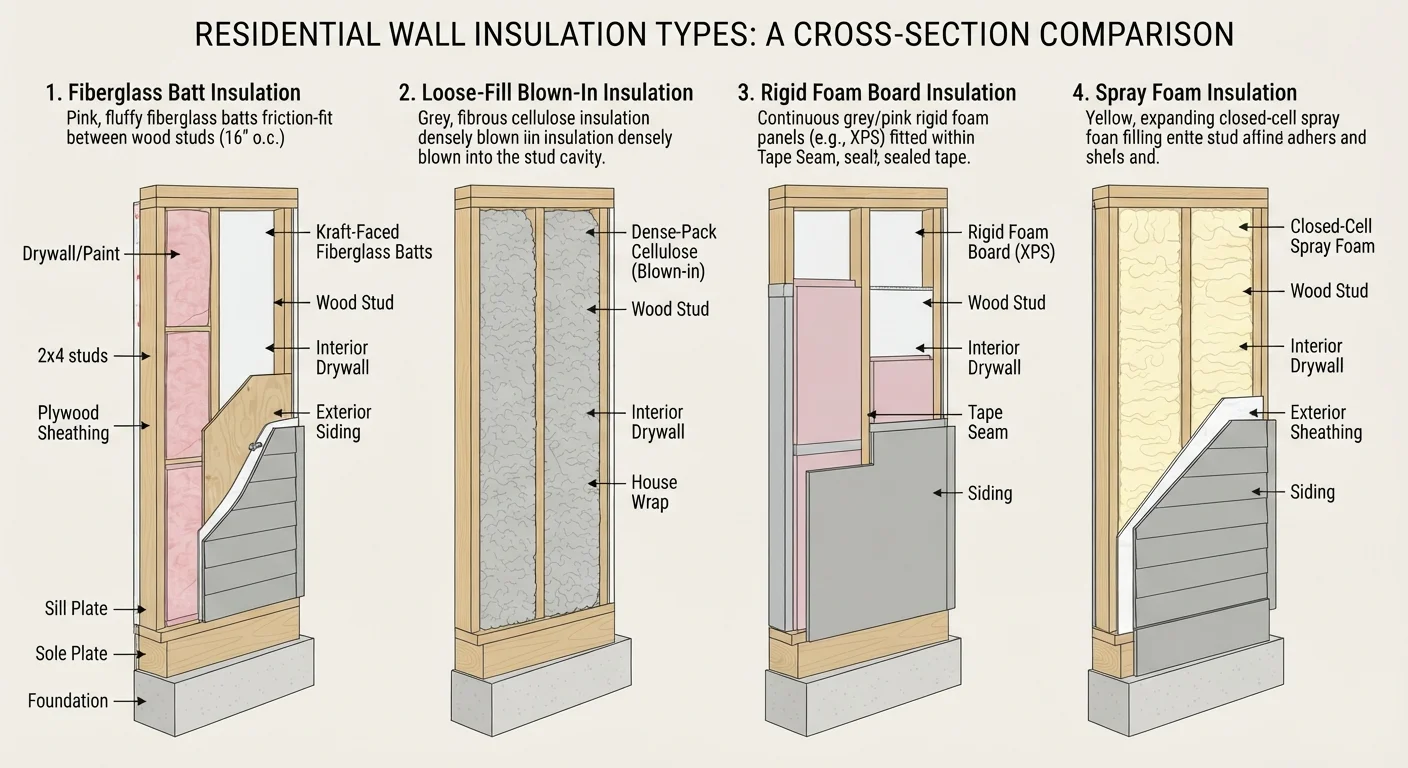
Photo: ReadersChronicle.com | Your Comprehensive Learning Destination editorial
—— In This Article
Key Takeaways
- Batt insulation is the most DIY-friendly option and works well in open wall cavities and attic floors.
- Blown-in insulation fills irregular spaces and existing walls without major demolition.
- Rigid foam boards add insulation to areas with limited depth, like basement walls or exterior sheathing.
- Spray foam delivers the highest air-sealing performance but requires professional installation.
Batt Insulation: The Familiar Choice for Open Cavities
Batt insulation - typically fiberglass or mineral wool - comes in pre-cut panels sized to fit standard stud and joist spacing. It's the format most homeowners recognize from hardware store shelves, and it remains one of the most straightforward options for anyone comfortable with basic DIY tasks.
Best applications: Open wall cavities before drywall is installed, attic floors between joists, and floors above unheated crawl spaces.
R-value range: Roughly R-3 to R-4 per inch for fiberglass; mineral wool runs slightly higher and resists moisture and fire more effectively.
Limitations: Batts must fit snugly to perform well. Gaps, compression, or improper cuts allow air to move around the material, reducing effective performance. They're also difficult to retrofit into finished walls without tearing out drywall.
Wear Protection When Handling Fiberglass Batts
Fiberglass fibers can irritate skin, eyes, and lungs. Always wear a long-sleeved shirt, gloves, safety glasses, and an N95 respirator when cutting or installing fiberglass batt insulation. Mineral wool batts are denser and less itchy but still require respiratory protection in dusty conditions.
Blown-In Insulation: Coverage Without Demolition
Blown-in (also called loose-fill) insulation uses a machine to blow loose fibers - usually fiberglass, cellulose, or mineral wool - into place. It's especially useful for adding insulation to finished spaces or irregular areas where batts can't reach.
Best applications: Existing attic floors, finished walls (via small drilled holes), and around obstructions like pipes or ceiling fixtures.
R-value range: Similar to batts - roughly R-2.5 to R-3.8 per inch depending on material and density. Cellulose, made from recycled paper, is a popular choice for its environmental profile and ability to settle into tight gaps.
DIY note: Blower machines are commonly available as rentals at home improvement centers. Wall installation - which involves drilling, blowing, and patching - is more involved and often best left to an insulation contractor.
For a complementary approach to reducing drafts alongside insulation, see our guide to caulking vs. weather stripping.
15-25%
Heating and cooling energy lost through attics
The U.S. Department of Energy estimates that air leaks and insufficient attic insulation account for roughly 15-25% of home heating and cooling losses.
R-38 to R-60
Recommended attic insulation for most U.S. climates
The EPA's ENERGY STAR program recommends attic insulation levels between R-38 and R-60 for most U.S. climate zones, depending on geography.
Rigid Foam Board: Thin Layers, High Performance
Rigid foam boards are manufactured panels of foam plastic insulation - most commonly EPS (expanded polystyrene), XPS (extruded polystyrene), or polyisocyanurate. Their strength is delivering meaningful R-value in thin profiles where there's no stud bay to fill.
Best applications: Basement walls, exterior wall sheathing, under slabs, and crawl space walls. They're also frequently used to add a continuous insulation layer over existing framing, which helps reduce thermal bridging (heat loss through the studs themselves).
R-value range: R-3.8 to R-6.5 per inch depending on foam type. Polyisocyanurate carries the highest R-value per inch of the three.
Important considerations: Most foam boards must be covered with a fire-rated material - typically drywall - when installed on interior surfaces. Check your local building code requirements before leaving foam exposed. Cutting and fitting requires care around edges and penetrations to avoid gaps.
| Batt | Blown-In | Rigid Foam | Spray Foam | |
|---|---|---|---|---|
| Typical R-value per inch | R-3 to R-4 | R-2.5 to R-3.8 | R-3.8 to R-6.5 | R-3.5 to R-7 |
| DIY-friendly? | Yes - most installs | Attics yes; walls need care | Yes with precautions | No - hire a pro |
| Best location | Open stud/joist bays | Attics, finished walls | Basements, exterior sheathing | Rim joists, irregular gaps |
| Air sealing ability | Low | Moderate | Moderate (with sealing) | Very high |
| Moisture resistance | Low (fiberglass) | Moderate (cellulose) | High (XPS/polyiso) | High (closed-cell) |
| Relative material cost | Low | Low to moderate | Moderate | High |
Spray Foam: Maximum Air Sealing With Professional Installation
Spray polyurethane foam (SPF) is applied as a liquid that expands and hardens in place, conforming to any shape and sealing air gaps as it cures. It comes in two main varieties: open-cell (lighter, lower R-value, vapor-permeable) and closed-cell (denser, higher R-value, moisture-resistant).
Best applications: Rim joists, irregular framing cavities, roof deck undersides, and areas where both insulation and a tight air barrier are needed simultaneously.
R-value range: Open-cell runs around R-3.5 per inch; closed-cell reaches R-6 to R-7 per inch and also acts as a vapor retarder.
Why professional installation matters: Two-component spray foam involves mixing chemicals under pressure. Improper mixing or application can result in off-ratio foam that doesn't cure correctly - and uncured foam releases irritants. Most residential spray foam projects should be handled by a licensed insulation contractor. Small-can DIY foam (like crack-fill aerosols) is appropriate for sealing minor gaps but is not a substitute for full spray foam systems.
If you're working on attic performance overall, our attic insulation and ventilation guide covers how insulation and airflow interact - an important pairing regardless of which material you choose.
Don't Seal Soffit Vents or Block Attic Airflow
When adding insulation to an attic floor, it's essential not to block soffit vents at the eaves. Blocking those vents traps moisture and can cause structural damage over time. Use rafter baffles (cardboard or foam channels) to maintain an air pathway from soffit to ridge, regardless of which insulation type you're using.

Home Editorial Team
Home Editorial Team is the collective byline for our editorial team and contributor network. Articles published under this byline or an editorial pen name are researched, written, and reviewed according to our editorial standards for clarity, consistency, and independence before publication.
View author profile