
Your Credit Report vs. Your Credit Score: Two Different Things
Confused about credit reports and credit scores? Here's how they differ, how they're connected, and why both matter to your finances.
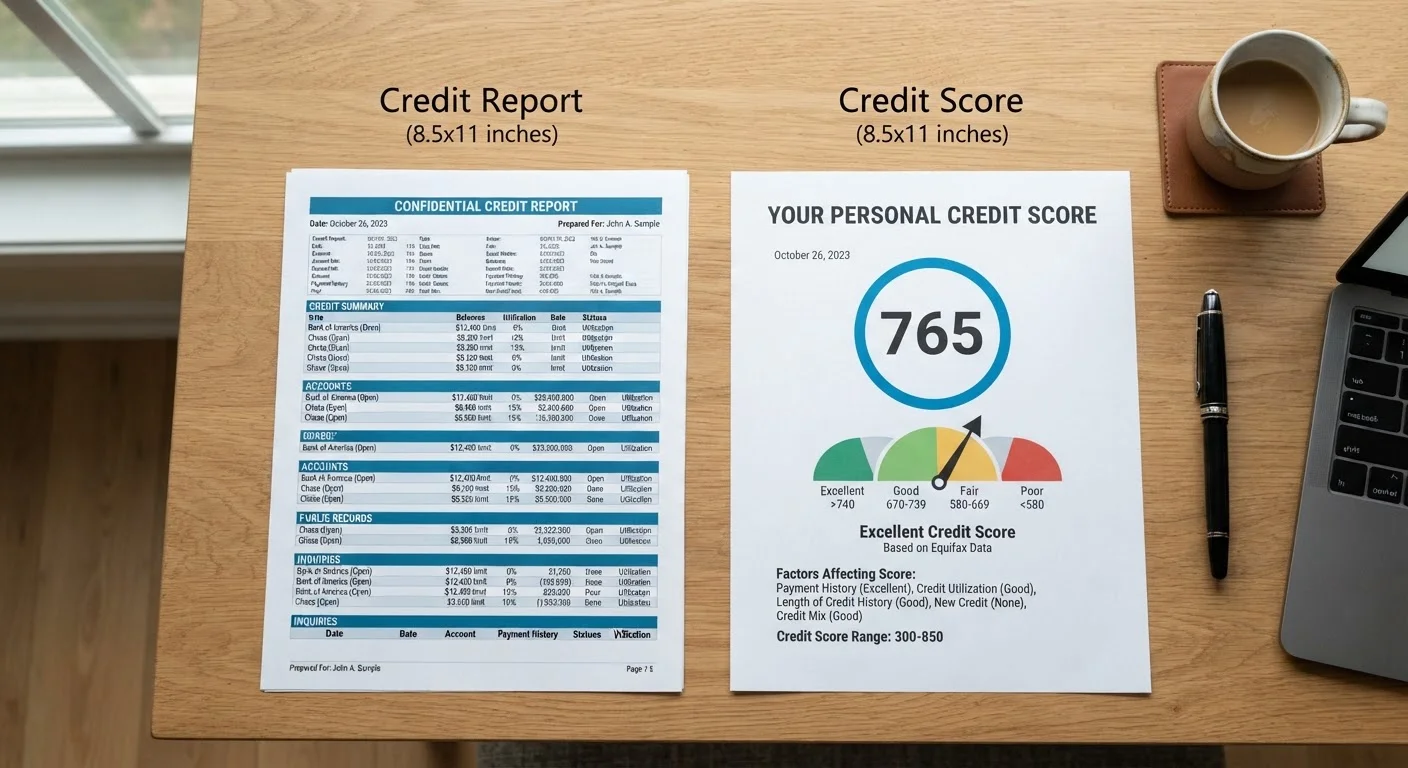
Photo: ReadersChronicle.com | Your Comprehensive Learning Destination editorial
—— In This Article
Key Takeaways
- Your credit report is a detailed history of your borrowing; your credit score is a number calculated from that history.
- Three major bureaus - Equifax, Experian, and TransUnion - maintain your credit reports independently.
- You're entitled to free credit report access regularly through AnnualCreditReport.com, but scores may cost extra.
- Errors on your credit report can drag down your score, so reviewing your report matters.
- Multiple scoring models exist, so your score can vary depending on which model a lender uses.
What Each One Actually Is
People use "credit report" and "credit score" interchangeably, but they're genuinely different things - and confusing them can lead to real blind spots in how you manage your finances.
A credit report is a detailed written record of your credit history, compiled by one of the three major credit bureaus: Equifax, Experian, or TransUnion. It lists every credit account you've opened, your payment history on each, how much you owe, how long accounts have been open, any collections or public records, and who has recently requested your credit information. Think of it as a financial biography.
A credit score is a three-digit number - typically ranging from 300 to 850 - that a scoring model calculates using the data in your credit report. The most widely known model is FICO, but VantageScore is another common one. The score condenses your entire credit history into a single number lenders can evaluate quickly. For a deeper look at what those numbers mean, see our plain-language guide to credit score ranges.
| Criterion | Credit Report | Credit Score |
|---|---|---|
| What it is | Detailed written history of your credit | Single three-digit number summarizing your risk |
| Who creates it | Equifax, Experian, TransUnion | Scoring models (e.g., FICO, VantageScore) |
| What's included | Accounts, balances, payments, inquiries, collections | A calculated number derived from report data |
| Free access | Yes, through AnnualCreditReport.com | Sometimes free via banks; not always guaranteed |
| Can vary by bureau? | Yes - each bureau tracks data independently | Yes - score differs based on report and model used |
| Best used for | Spotting errors, reviewing full history | Gauging creditworthiness before applying for credit |
How They're Connected - and Where They Differ
The relationship is one-way: your credit report feeds your credit score, but the score doesn't affect the report. When a lender or creditor sends updated information to the bureaus, your report changes. Scoring models then read those changes and recalculate your score.
Because each bureau maintains its own file independently, your report - and therefore your score - can vary slightly across all three. A lender who pulls only one bureau's data may see a different number than one who pulls all three. The five factors that shape your score - including payment history and credit utilization - all originate from data inside your report.
One key practical difference: access and cost. Federal law entitles most consumers to free credit report access from each bureau through AnnualCreditReport.com. Your credit score, however, is not always free - many banks and card issuers now provide it as a benefit, but it's not universally guaranteed at no charge.
1 in 5
Consumers with credit report errors
A Federal Trade Commission study found that roughly one in five consumers had an error on at least one of their credit reports.
300-850
Typical FICO score range
Most FICO scoring models use this range; higher scores generally indicate lower credit risk to lenders.
3
Major credit bureaus in the U.S.
Equifax, Experian, and TransUnion each maintain separate credit files, which is why your report and score can differ across bureaus.
Why Both Matter and What to Do With Them
Knowing your score is useful when you're planning a major financial move - applying for a mortgage, auto loan, or credit card. It tells you roughly where you stand before a lender makes that judgment for you.
But your report is where real problems hide. Errors - a payment incorrectly marked late, an account that isn't yours, a balance that wasn't updated - can quietly suppress your score. The Consumer Financial Protection Bureau (CFPB) recommends reviewing your reports from all three bureaus periodically, not just once. For help reading what you find, see our walkthrough of every credit report section.
If something looks wrong on your report, you have the right to dispute it with the bureau that issued it. The bureau is required to investigate and correct genuine errors. Your score will reflect any corrections once the report is updated.
Checking Your Own Report Doesn't Hurt Your Score
When you pull your own credit report or score, it's recorded as a "soft inquiry" and has no effect on your credit score. Only "hard inquiries" - triggered when a lender checks your credit as part of an application - can have a small, temporary impact. Checking your own credit regularly is a smart habit, not a risk.
This article is for general informational and educational purposes only. It is not personalized financial or legal advice. For guidance specific to your situation, consider consulting a licensed financial adviser or credit counselor.

Finance Editorial Team
Finance Editorial Team is the collective byline for our editorial team and contributor network. Articles published under this byline or an editorial pen name are researched, written, and reviewed according to our editorial standards for clarity, consistency, and independence before publication.
View author profile