
Fiber vs. Cable Internet: Which One Actually Delivers?
A side-by-side look at fiber and cable internet — speed consistency, upload performance, availability, and cost differences.
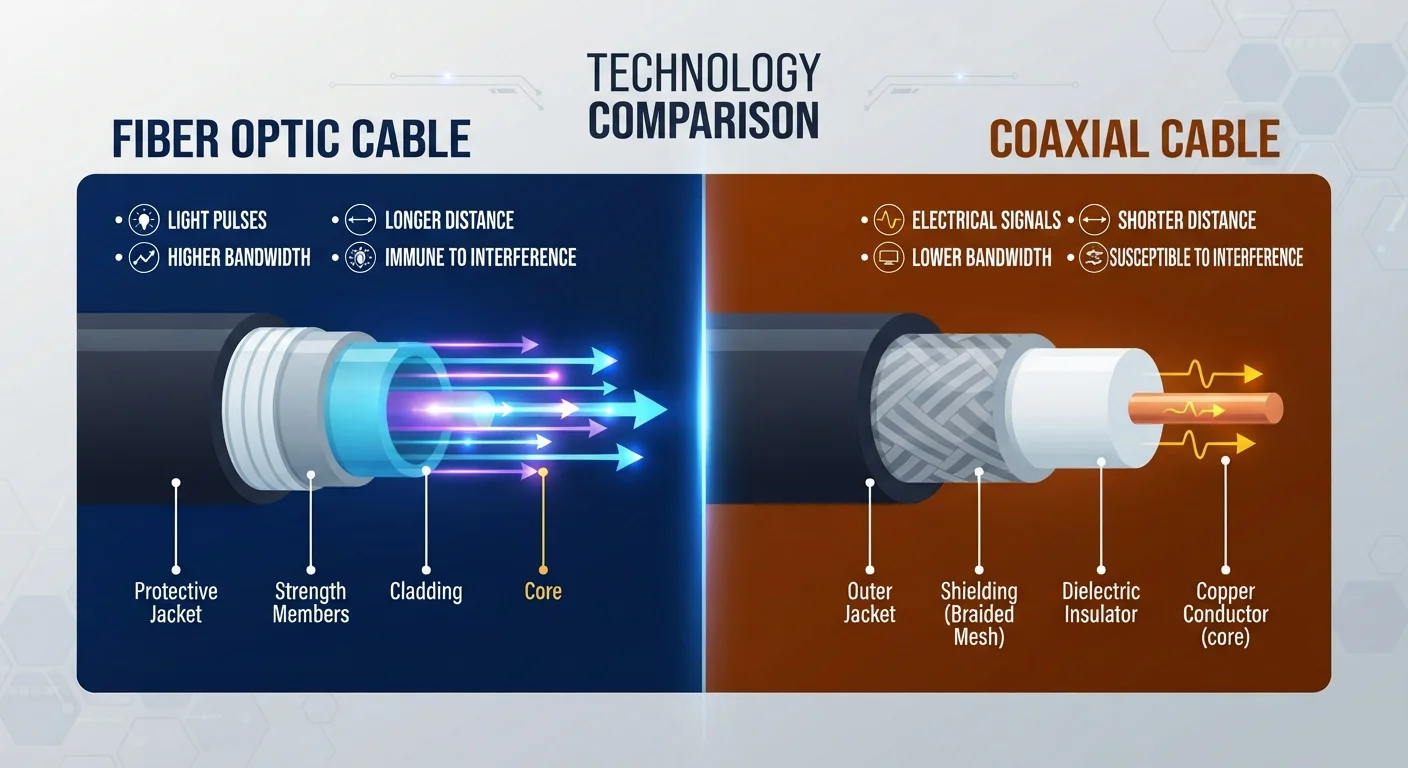
Photo: ReadersChronicle.com | Your Comprehensive Learning Destination editorial
—— In This Article
Key Takeaways
- Fiber delivers equal upload and download speeds; cable upload speeds are typically much slower.
- Cable internet is available in far more US households than fiber infrastructure currently reaches.
- Shared cable nodes can cause slowdowns during peak evening hours in dense neighborhoods.
- Fiber signals do not degrade over distance the way cable signals can on longer runs.
- Neither technology is universally cheaper - plan pricing varies significantly by provider and region.
- Availability, not just performance, is often the deciding factor for most households.
How the Two Technologies Actually Work
The core difference between fiber and cable internet is physical: what the signal travels through. Fiber-optic internet transmits data as pulses of light through thin glass or plastic strands. Cable internet uses the same coaxial copper cable infrastructure originally built for television service, carrying electrical signals to deliver broadband.
That infrastructure difference has real consequences. Fiber signals travel at the speed of light and experience almost no degradation over distance. Coaxial cable signals weaken as the run from the provider's node to your home gets longer, and performance can be affected by the condition of the cable plant in your neighborhood.
Cable networks also rely on a shared node model - meaning dozens or hundreds of homes in your area draw from the same local connection point. Fiber typically provides a dedicated connection all the way to your home (FTTH) or to a nearby building (FTTB). That architectural difference is the root cause of most performance gaps between the two.
For a broader look at how ISPs package and market these connections, see our guide to internet plan myths that cost people money.
| Criterion | Fiber Internet | Cable Internet |
|---|---|---|
| Signal medium | Light through glass/plastic fiber | Electrical signal through coaxial copper |
| Download speeds | Up to 1-5 Gbps on top tiers | Typically 100 Mbps-1 Gbps |
| Upload speeds | Symmetrical (matches download) | Asymmetrical - often 20-50 Mbps |
| Consistency during peak hours | High - dedicated connection | Variable - shared neighborhood node |
| Signal degradation over distance | Minimal | Increases with longer cable runs |
| US household availability | Growing but limited coverage | Broad - majority of US homes |
| Typical infrastructure model | Dedicated line to home (FTTH/FTTB) | Shared node serving many homes |
Speed, Consistency, and Upload: Where the Gap Is Real
Advertised download speeds on cable plans can look impressive on paper - often 200 Mbps to 1 Gbps on higher tiers. However, two factors regularly undercut real-world performance: upload speed asymmetry and shared congestion.
Cable's DOCSIS standard is engineered to prioritize downloads over uploads. A cable plan advertising 400 Mbps download may offer only 20-35 Mbps upload. For users who video call, back up data to the cloud, or share large files, that upload ceiling becomes a genuine friction point - not a technical footnote.
Fiber plans are typically symmetrical: a 500 Mbps plan delivers 500 Mbps in both directions. This matters increasingly as remote work, content creation, and multi-device households become the norm rather than the exception.
~35 Mbps
Typical cable upload speed on mid-tier plans
FCC Measuring Broadband America reports consistently document a large gap between cable download and upload throughput on standard residential plans.
Symmetrical
Fiber upload-to-download speed ratio
Fiber-optic connections are engineered to deliver matching upload and download bandwidth, a structural advantage over the cable architecture.
~45%
US homes with access to fiber broadband
FCC broadband coverage estimates indicate fiber availability has grown substantially but still trails cable's reach across the US population.
Congestion is the second variable. Because cable nodes are shared, evening hours - when entire neighborhoods stream simultaneously - can produce noticeable slowdowns even on nominally fast plans. Fiber's dedicated architecture insulates subscribers from this neighborhood-level contention.
Cable providers have introduced DOCSIS 3.1 and are developing DOCSIS 4.0 to close the upload gap, but fiber's symmetrical design remains an inherent structural advantage today.
Availability and Cost: The Practical Reality
Performance advantages mean nothing if the technology isn't available at your address. Fiber infrastructure, despite rapid expansion, still reaches a minority of US homes compared to cable. According to FCC data, cable broadband covers the large majority of the US population, while fiber availability - though growing quickly - remains concentrated in urban centers and newer suburban developments.
If you live in a rural area, neither fiber nor cable may be accessible, in which case fixed wireless or satellite internet may be your realistic options. Our realistic look at satellite internet for rural households covers that landscape in detail.
What If Neither Fiber nor Cable Is Available?
Consumers in underserved areas may find that fixed wireless or DSL are the only wired-equivalent options. Our comparison of DSL and fixed wireless covers how those technologies stack up for households where cable and fiber infrastructure hasn't arrived. Each comes with its own trade-offs on speed, reliability, and cost.
On pricing, neither technology is categorically cheaper. Entry-level cable plans can be attractively priced, but promotional rates often give way to higher standard rates after an introductory period. Fiber plans similarly vary. Before committing, review the full contract terms carefully - our guide to reading an ISP offer walks through the fees and fine print that matter most.
When fiber is available in your area, the pricing difference from comparable cable plans is often smaller than consumers expect, particularly when factoring in equipment rental fees and the potential for more consistent long-term performance.

Tech Editorial Team
Tech Editorial Team is the collective byline for our editorial team and contributor network. Articles published under this byline or an editorial pen name are researched, written, and reviewed according to our editorial standards for clarity, consistency, and independence before publication.
View author profile