
Appraised Value, Market Value, and Assessed Value: Three Numbers That Mean Very Different Things
These three property valuations often get confused, but each serves a distinct purpose. Learn what sets them apart and when each one applies.
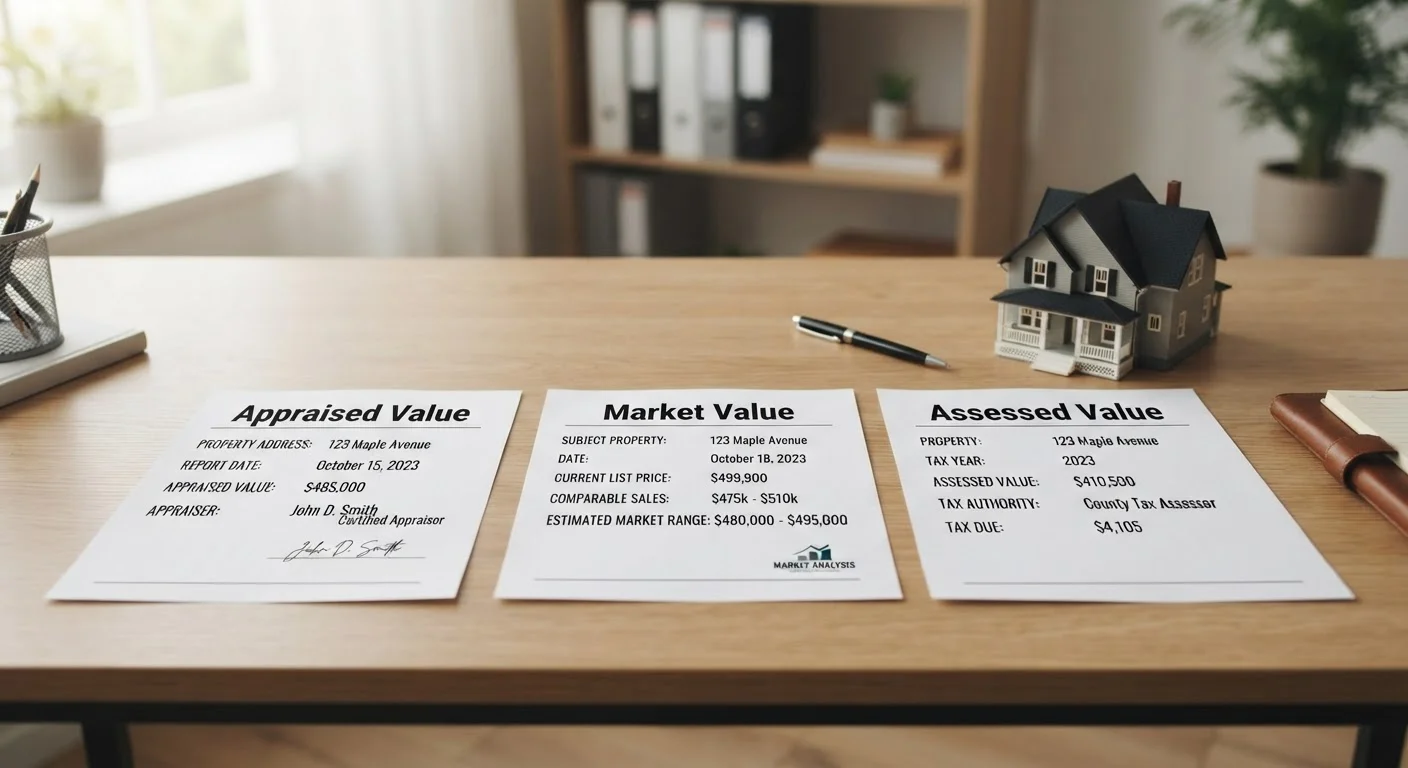
Photo: ReadersChronicle.com | Your Comprehensive Learning Destination editorial
—— In This Article
Key Takeaways
- Appraised value is determined by a licensed professional and is primarily used by mortgage lenders.
- Market value reflects what a buyer is actually willing to pay for a property right now.
- Assessed value is set by a local government and is used only to calculate property taxes.
- All three numbers can differ significantly for the same property at the same time.
- Knowing which number applies to your situation prevents costly misunderstandings.
Why These Three Terms Get Confused
Walk through any real estate transaction and you'll encounter at least two of these valuations - sometimes all three at once. A seller checks what similar homes sold for, a lender orders an appraisal, and the county sends a tax bill based on its own number. Each figure can differ by tens of thousands of dollars for the exact same property.
The confusion is understandable: all three claim to tell you what a home is "worth." But they each answer a different question, use different methodologies, and carry authority in different contexts. Mixing them up can lead to real consequences - overbidding, mortgage shortfalls, or overpaying on taxes you could have challenged.
Understanding these distinctions is also useful background when you're exploring financing. See how lenders evaluate your overall financial picture in our guide to mortgage pre-qualification vs. pre-approval.
Appraised Value: What a Lender Needs to Know
Appraised value is the opinion of worth produced by a licensed or certified real estate appraiser, typically hired by a mortgage lender before approving a home loan. The appraiser physically inspects the property, reviews recent sales of comparable homes (called "comps"), and applies standardized methodologies to arrive at a specific dollar figure.
Why does the lender care? Because the home serves as collateral for the loan. If the appraised value comes in lower than the agreed purchase price - a situation called a low appraisal - the lender will only finance up to the appraised amount. That gap becomes the buyer's problem to resolve, either by renegotiating the price, covering the difference in cash, or walking away.
When You May Encounter All Three at Once
During a home purchase, your agent provides a market value estimate, your lender orders an appraisal, and your future tax bill will be based on the county's assessed value. All three numbers may differ - and that's normal. Track each figure separately and know which one is relevant to the decision in front of you.
Appraisals are also used in refinancing, home equity loans, and estate settlements - any situation where an impartial, documented valuation is needed for a financial decision.
Market Value: What Buyers and Sellers Actually Negotiate
Market value is the price a willing buyer would pay a willing seller when neither is under pressure to act and both have reasonable knowledge of the facts. It is not a formal calculation - it is an economic reality shaped by supply, demand, location, condition, and timing.
Real estate agents use Comparative Market Analysis (CMA) reports to estimate market value before listing a home. These reports examine recent nearby sales, active listings, and market trends. But the final proof of market value is the price agreed upon in an actual transaction.
Market value can be higher or lower than an appraised value. In a competitive market with multiple offers, a home might sell above its appraised value. In a slow market, it might sell below. Neither outcome is inherently wrong - it simply reflects conditions at that moment in time.
| Appraised Value | Market Value | Assessed Value | |
|---|---|---|---|
| Who sets it | Licensed appraiser | Buyer-seller negotiation | Local government assessor |
| Primary purpose | Mortgage lending decisions | Pricing and offers | Property tax calculation |
| How often updated | Per transaction or refinance | Continuously, by the market | Annually or per state schedule |
| Formal inspection required | Yes, by the appraiser | No formal requirement | Typically no physical inspection |
| Can you challenge it | Yes, via lender reconsideration | No - it's a negotiation outcome | Yes, via formal tax appeal |
| Reflects current market speed | Fairly current | Real-time | Often lags behind market |
Assessed Value: What the Tax Collector Uses
Assessed value is assigned by your local government's assessor's office and exists for one primary purpose: calculating your annual property tax bill. It is determined by a mass appraisal process - assessors apply uniform formulas across large numbers of properties rather than inspecting each one individually.
Most jurisdictions set assessed value as a percentage of market value, called the assessment ratio. A home with a $400,000 market value in a county with an 80% assessment ratio would carry an assessed value of $320,000. Multiply that by the local mill rate (the tax rate per $1,000 of assessed value) and you get your annual tax bill.
Crucially, assessed values often lag behind the real estate market - they may be updated annually, every few years, or only upon sale, depending on the state. If you believe your assessed value is inaccurate, most jurisdictions offer a formal appeals process.
Don't Assume Assessed Value Reflects Market Reality
A low assessed value does not mean a home is a bargain - it simply reflects how the local government values it for tax purposes. Similarly, a high assessed value doesn't always mean a home will sell for that amount. Never use assessed value alone to estimate what a property is worth in a sale or purchase context.
Getting comfortable with these distinctions connects to broader financial literacy. For example, understanding how lenders evaluate risk is also useful when exploring pre-qualification vs. pre-approval before house hunting.
This article is for general informational and educational purposes only and does not constitute financial, legal, or tax advice. Property valuation rules, assessment ratios, and appeals processes vary by state and locality. Consult a licensed real estate professional, appraiser, or tax adviser for guidance specific to your situation.

Real Estate Basics Editorial Team
Real Estate Basics Editorial Team is the collective byline for our editorial team and contributor network. Articles published under this byline or an editorial pen name are researched, written, and reviewed according to our editorial standards for clarity, consistency, and independence before publication.
View author profile