
Household Fasteners Decoded: Nails, Screws, Bolts, and Anchors
A practical reference guide to common fastener types, what each is designed for, and how to match the right fastener to your project.
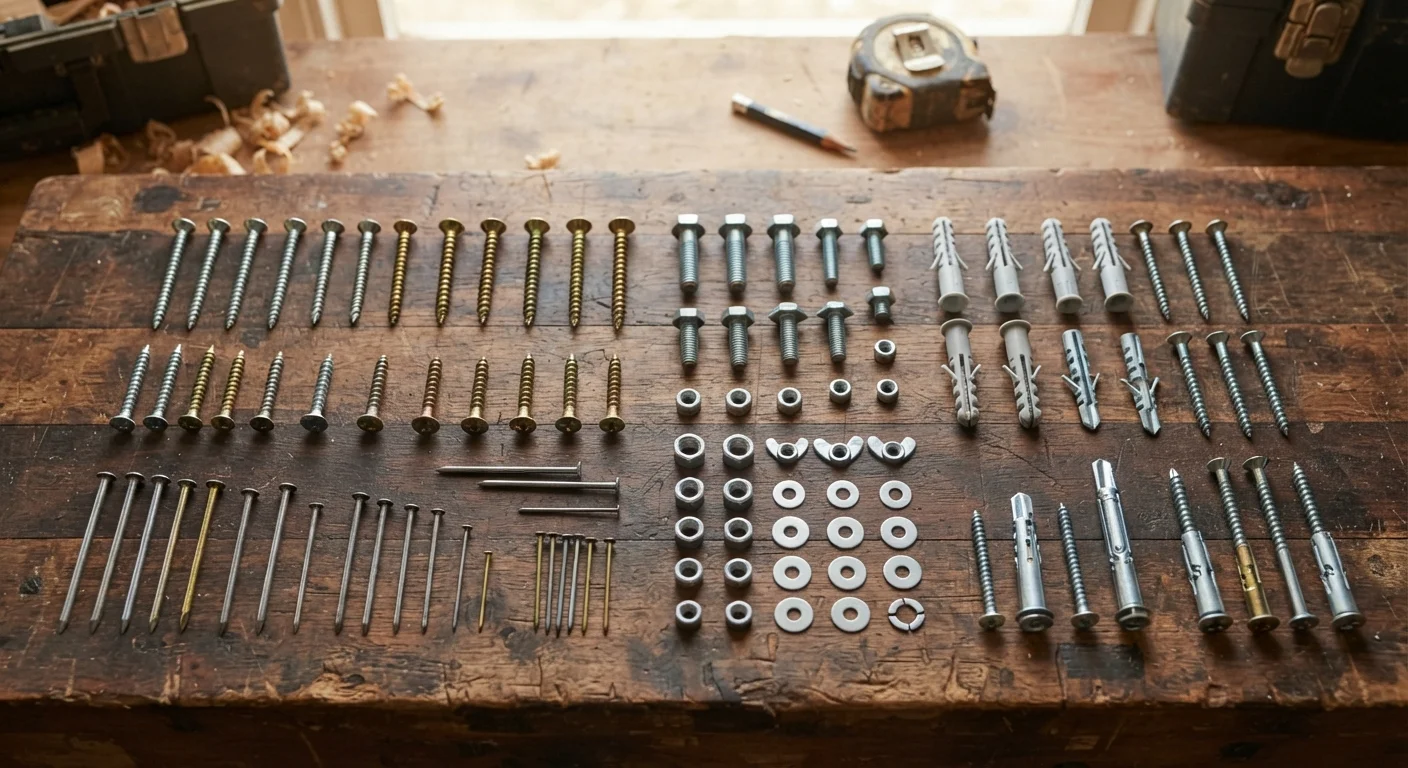
Photo: ReadersChronicle.com | Your Comprehensive Learning Destination editorial
—— In This Article
Why Fastener Choice Actually Matters
Walk into any hardware store and you'll face bins of hundreds of fasteners. Grabbing the wrong one doesn't just mean a wobbly shelf - it can mean a falling mirror, a cracked cabinet, or a stripped hole that's harder to fix than the original problem. This reference guide cuts through the confusion so you can confidently match the fastener to the job.
| Fastener families | 4 main types: nails, screws, bolts, anchors |
| Best for pull-out strength | Screws (threaded grip outperforms driven nails) |
| Best for shear load | Nails (especially ring-shank or spiral varieties) |
| Outdoor fastener rule | Must be corrosion-rated (galvanized, stainless, or ACQ-compatible) |
| Drywall anchor max (plastic sleeve) | Typically under 20 lb. - verify product spec |
| Safest drywall hang | Drive into a wall stud whenever possible |
Fasteners fall into four broad families: nails, screws, bolts, and anchors. Each is engineered for different load types, materials, and permanence levels. Understanding a few key principles makes every hardware store visit faster and less expensive.
Nails: Speed and Shear Strength
Nails are driven rather than threaded, which makes them fast to install but generally weaker in pull-out (withdrawal) strength compared to screws. They excel at handling shear loads - forces applied sideways, such as the weight of wall sheathing or framing lumber.
- Common/framing nails: Thick, blunt-tipped nails for structural framing. Typically 8d (2.5 in.) to 16d (3.5 in.) in length.
- Finish nails: Slender with a small head that can be set below the surface and filled. Used for trim, molding, and cabinetry where appearance matters.
- Brad nails: Even thinner than finish nails; used for delicate trim or thin stock where splitting is a risk.
- Ring-shank and spiral nails: Textured shanks that grip wood fibers more aggressively. Common in decking and subflooring where pull-out resistance is needed.
As a general rule: if the connection will bear dynamic or heavy loads and must stay tight over time, a screw will outperform a nail.
Screws: Holding Power and Adjustability
Screws convert rotational force into clamping pressure through their helical threads, giving them far superior pull-out resistance compared to nails of the same length. They can also be removed and redriven, making them the go-to for most home repair and improvement tasks.
Shear load
A force applied perpendicular to the length of a fastener - essentially pushing it sideways rather than pulling it straight out. Nails handle shear loads well; screws handle pull-out loads better.
Pull-out (withdrawal) strength
A fastener's resistance to being pulled straight out of the material it's embedded in. Screws generally have much higher withdrawal strength than nails of the same size.
Cam-out
When a screwdriver or bit slips out of the fastener head during driving, often stripping the recess. Square (Robertson) and Torx drives are engineered to reduce cam-out.
Through-bolt
A bolt that passes completely through all joined materials and is secured with a nut on the far side, distributing load across both surfaces for maximum strength.
Corrosion-rated hardware
Fasteners with coatings or alloys (such as hot-dipped galvanized or stainless steel) that resist rust when used outdoors or with treated lumber. Standard zinc plating is not adequate for these environments.
Self-tapping screw
A screw with a hardened tip that cuts its own mating threads as it's driven, eliminating the need to pre-drill a tapped hole. Common in sheet-metal and some plastic applications.
- Wood screws: Tapered shank and coarse threads designed to bite into solid wood. The unthreaded shank near the head helps draw two pieces of wood tightly together.
- Drywall screws: Sharp, self-starting tips and coarse or fine threads depending on whether they're going into wood or metal studs. Do not substitute these for structural connections - they are brittle.
- Deck screws: Corrosion-resistant coatings (look for ACQ-compatible ratings) for outdoor use in pressure-treated lumber.
- Sheet-metal screws: Fully threaded with sharp points designed to tap their own threads into thin metal.
- Machine screws: Uniform threads along the full shank; used with a nut or a pre-tapped hole, not driven directly into wood.
Match the screw's drive type (Phillips, square/Robertson, Torx, slotted) to what your driver bits can handle. Square and Torx drives are less prone to cam-out - the frustrating slip that strips the head.
Bolts: When You Need Maximum Strength
Bolts pass all the way through the materials being joined and are tightened with a nut on the opposite side. This through-bolt approach distributes load across a larger bearing area, making bolts the right choice for connections that must withstand significant tension or shear - deck ledger boards, structural brackets, or assembling heavy furniture.
4×
Screw pull-out vs. nail withdrawal strength
Engineering tests commonly show screws achieve roughly four times the withdrawal resistance of smooth-shank nails of comparable size in solid wood.
~100 lb.
Typical toggle bolt drywall capacity
Heavy-duty toggle bolts in ½-inch drywall can support approximately 100 lb. or more per bolt - always verify the load rating on the specific product packaging.
- Hex bolts: The standard workhorse. Used with a flat washer and nut; a lock washer helps prevent loosening from vibration.
- Carriage bolts: Smooth, domed head with a square shoulder beneath it that bites into wood to prevent spinning. Common in deck and fence construction.
- Lag bolts (lag screws): Large, coarse-threaded fasteners driven with a wrench rather than a screwdriver. Used to attach ledger boards and heavy structural members where a through-bolt isn't practical.
Always use washers under bolt heads and nuts to spread the load and prevent the fastener from pulling through the material. When connecting to treated lumber outdoors, choose hardware rated for that specific preservative treatment - standard zinc plating can corrode rapidly.
Anchors: Securing to Walls Without a Stud
Wall anchors solve a common problem: you need to hang something, but there's no stud behind the drywall at that exact spot. Different anchor types handle very different load ranges, so matching the anchor to the weight is critical.
- Plastic expansion anchors: The cheapest option. Insert the plastic sleeve, then drive a screw in to expand it. Suitable only for very light loads (under about 20 lb.) in drywall or plaster.
- Self-drilling drywall anchors ("E-Z anchors"): Drill their own hole as you drive them with a screwdriver. More holding capacity than basic plastic sleeves, but still limited to light-to-medium loads.
- Toggle bolts: A spring-loaded metal wing folds to pass through the hole, then opens flat against the back of the drywall. Offer significantly higher load capacity - useful for heavier mirrors or shelving brackets.
- Snap toggles (strap toggles): A plastic strap holds a metal channel against the back of the wall while you tighten the bolt. Reusable hole if you remove the bolt. Good for medium-to-heavy loads.
- Concrete/masonry anchors: Sleeve anchors, wedge anchors, and Tapcon-style screws are designed for concrete or brick. These require a hammer drill and the correct masonry bit.
Check Local Codes for Structural Work
Fastener requirements for structural connections - deck ledger boards, stair stringers, load-bearing brackets - are often specified in local building codes. Using undersized or incorrect fasteners in these applications can create a safety hazard and may not pass inspection. When in doubt on structural projects, consult a licensed contractor or your local building department before proceeding.
When in doubt about load capacity - especially for TVs, mirrors, or shelves holding significant weight - use a stud finder and drive into solid framing. No anchor in open drywall matches the holding power of a screw in a stud.
Quick Selection Guide
Use this summary when you're standing in the hardware aisle deciding what to grab:
| Task | Recommended Fastener |
|---|---|
| Framing walls or floors | Structural framing nails or structural screws |
| Hanging trim or molding | Finish nails or brad nails |
| General wood assembly | Wood screws (coarse thread) |
| Attaching drywall | Drywall screws |
| Deck or outdoor structures | Deck screws or carriage/lag bolts (corrosion-rated) |
| Hanging light items on drywall | Self-drilling drywall anchor + screw |
| Hanging heavy items on drywall | Toggle bolt or snap toggle into stud when possible |
| Masonry or concrete | Masonry anchor or Tapcon-style screw (hammer drill required) |
Just as it helps to decode unfamiliar terminology in other areas - see our plain-English glossary approach for how that works in tech - having a clear reference for fastener types puts the decision-making power in your hands without needing to pay for expert advice on every small project.

Home Editorial Team
Home Editorial Team is the collective byline for our editorial team and contributor network. Articles published under this byline or an editorial pen name are researched, written, and reviewed according to our editorial standards for clarity, consistency, and independence before publication.
View author profile