
State Minimum vs. Recommended Coverage Limits: Understanding the Gap
Meeting your state's minimum requirement is legal—but may leave you exposed. Learn what minimums cover and where they often fall short.
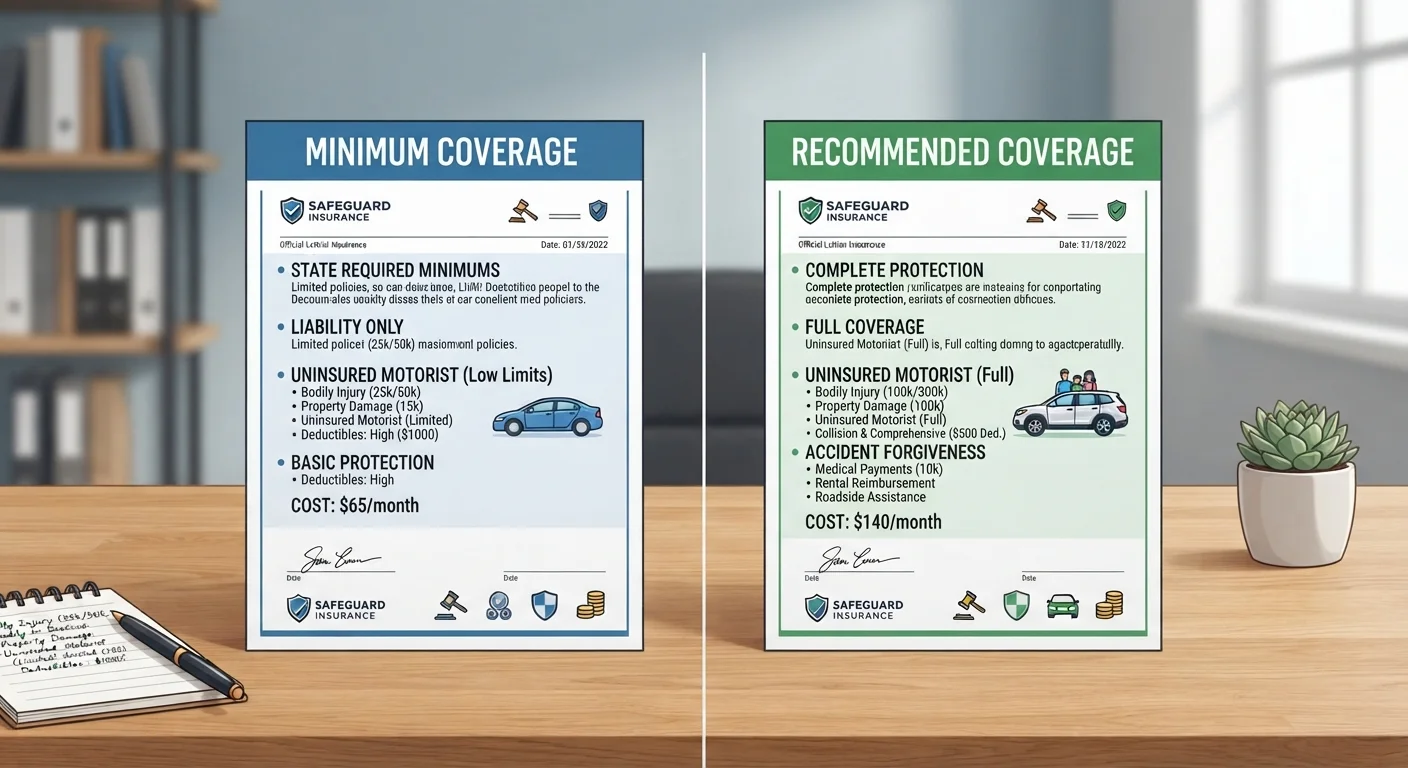
Photo: ReadersChronicle.com | Your Comprehensive Learning Destination editorial
—— In This Article
Key Takeaways
- State minimums set the legal floor for liability coverage - not the amount you'd actually need after a serious crash.
- Common minimums like 25/50/25 can be exhausted quickly in a multi-vehicle or injury-heavy accident.
- Insurance professionals widely suggest limits of at least 100/300/100 for meaningful liability protection.
- If an accident exceeds your limits, you're personally responsible for the remaining costs.
- Higher limits typically cost less than most drivers expect when compared to the risk they offset.
What State Minimums Actually Mean
Every state that requires auto insurance sets a floor - a minimum amount of liability coverage you must carry to legally operate a vehicle. These minimums are typically expressed as three numbers, such as 25/50/25, which breaks down as follows:
- $25,000 per person for bodily injury
- $50,000 per accident for total bodily injury
- $25,000 per accident for property damage
These numbers represent the maximum your insurer will pay to other parties when you cause an accident. They do not cover your own injuries or vehicle damage - those require separate coverage types. For a fuller explanation of how liability fits into the overall picture, see what each coverage type actually covers.
State minimums exist to ensure that at-fault drivers can pay something toward the harm they cause - not to make the injured party whole. That distinction matters enormously when real-world accident costs are considered.
New Hampshire and Virginia Are Exceptions
Most states require minimum liability insurance, but rules vary. Historically, New Hampshire has not mandated insurance for most drivers, though financial responsibility laws still apply after an accident. Virginia has had opt-out provisions tied to fees. If you live in an atypical state, verify current requirements directly with your state's DMV or insurance commissioner, as rules can change.
Where Minimums Fall Short: The Numbers Problem
The gap between minimums and reality becomes clear fast. A single hospitalization after a serious crash can run well into six figures. A totaled late-model SUV can easily exceed $40,000 in property damage. When multiple people are injured, costs compound quickly.
Consider a 25/50/25 policy: if you cause an accident injuring two people with combined medical bills of $80,000, your policy covers only $50,000. The remaining $30,000 becomes your personal liability - meaning the injured parties can pursue your wages, savings, or property to recover it.
$25,000
Most common property damage minimum
According to the Insurance Information Institute, many states set property damage liability minimums at $25,000 - an amount easily exceeded by newer vehicles.
1 in 8
Drivers estimated to be uninsured
The Insurance Research Council has estimated roughly one in eight US drivers carries no auto insurance, increasing the risk exposure for everyone on the road.
This is why the financial exposure from low limits isn't theoretical. It's a direct, legally enforceable gap between what your insurer pays and what you owe.
For a broader look at how coverage decisions interact with your budget, this framework for budget-conscious drivers walks through the trade-offs clearly.
What 'Recommended' Limits Look Like - and Why
Insurance professionals and consumer advocates commonly suggest liability limits of at least 100/300/100 - meaning $100,000 per person, $300,000 per accident for bodily injury, and $100,000 for property damage. Some suggest going higher if you have significant assets to protect.
| Criterion | State Minimum (e.g. 25/50/25) | Recommended Limits (e.g. 100/300/100) |
|---|---|---|
| Bodily injury per person | $25,000 | $100,000 |
| Bodily injury per accident | $50,000 | $300,000 |
| Property damage per accident | $25,000 | $100,000 |
| Legal compliance | Yes | Yes |
| Protection against personal liability | Limited - gaps are common | Significantly stronger |
| Typical premium impact | Lowest available | Moderately higher |
| Covers your own injuries/vehicle | No - requires separate coverage | No - requires separate coverage |
The reasoning is straightforward: the premium difference between minimum and recommended limits is typically smaller than most drivers expect, while the coverage difference is substantial. A policy upgrade from 25/50/25 to 100/300/100 often costs a modest amount more per month - an amount that pales against potential out-of-pocket liability after a serious crash.
That said, recommended limits aren't a universal answer. Your actual needs depend on the assets you're protecting, how often and where you drive, and what you can genuinely afford. Our plain-language guide to auto insurance can help you understand the full landscape of coverage decisions.
This article is for general informational purposes only and does not constitute personalized insurance, financial, or legal advice. Coverage needs vary by individual circumstances. Consult a licensed insurance professional before making decisions about your own policy.

Cars Editorial Team
Cars Editorial Team is the collective byline for our editorial team and contributor network. Articles published under this byline or an editorial pen name are researched, written, and reviewed according to our editorial standards for clarity, consistency, and independence before publication.
View author profile